

Introduction
Alpha-ketoglutarate (AKG), also called 2-oxoglutarate, is a normal molecule in the tricarboxylic-acid cycle, or TCA cycle—the mitochondrial network that processes carbon during cellular energy metabolism. What makes AKG particularly relevant to epigenetic ageing is a second role: it is consumed by a large group of enzymes called α-ketoglutarate-dependent dioxygenases. Several members of this enzyme family modify DNA and histones. (Review)
Two enzyme groups are especially important. TET enzymes participate in DNA-demethylation pathways, while many Jumonji-domain histone demethylases remove methyl groups from particular positions on histone proteins. Because both require AKG, cellular metabolism can directly influence epigenetic chemistry. (Review, Review)
That strong biochemical mechanism has encouraged interest in supplemental AKG—particularly calcium alpha-ketoglutarate (CaAKG)—as a possible geroscience intervention. The human evidence is much weaker than the mechanism. A frequently cited study reported a substantial decline in a DNA-methylation-age estimate after a CaAKG-plus-vitamin formulation, but it was an uncontrolled before/after analysis and could not isolate the effect of AKG. (Research)
This distinction defines the field: AKG clearly participates in epigenetic demethylation chemistry, but oral AKG has not been shown to selectively erase harmful age-associated methylation marks, rejuvenate human organs, or extend human lifespan.
Informational only; no medical, dosing, or emergency instructions.
Quick Summary
- AKG is both a TCA-cycle metabolite and a required co-substrate for several oxygen- and iron-dependent enzymes. (Review)
- TET1, TET2 and TET3 use AKG while oxidizing methylated cytosine in DNA-demethylation pathways. (Review)
- Many Jumonji-domain histone demethylases use AKG and Fe²⁺ to remove methyl groups from selected histone residues. (Review)
- Succinate and fumarate can competitively inhibit several AKG-dependent DNA and histone demethylases in experimental systems. (Research)
- A retrospective study of 42 adults reported a lower DNA-methylation-age estimate after a CaAKG-plus-vitamin formulation, but there was no placebo group and CaAKG was not isolated. (Research)
- A 2026 observational study found a lower biological-age residual among users of a delayed-release CaAKG-plus-vitamin formulation, but the design cannot establish causality. (Research)
- Human AKG salts have also been studied in osteopenia, exercise, severe burns and surgical nutrition, but those studies did not demonstrate epigenetic rejuvenation. (Research, Research)
- One mouse study reported CaAKG-associated lifespan extension, while a 2026 genetically heterogeneous mouse experiment did not reproduce lifespan extension. (Research, Research)
- A topical AKG-containing cosmetic formulation has human skin data, but the findings are local and formulation-specific. (Research)
- No controlled human evidence establishes that AKG produces durable whole-body epigenetic rejuvenation or extends human lifespan. (Review)
What It Is (Clinical Definition & Classification)
AKG is a five-carbon organic acid produced naturally by human cells. In the TCA cycle, it is generated from isocitrate and subsequently converted toward succinyl-CoA. AKG also connects the TCA cycle with amino-acid metabolism because glutamate can be converted to or from AKG through transamination and related reactions. (Review)
From an epigenetic perspective, AKG belongs to a group of metabolites that regulate chromatin-modifying enzymes by controlling their substrate environment. It is therefore more accurate to call AKG a metabolic epigenetic modulator than an epigenome editor. (Review)
A co-substrate is a molecule consumed during an enzyme reaction. AKG-dependent dioxygenases use AKG together with oxygen, generally producing succinate and carbon dioxide as reaction products. AKG is therefore chemically involved in the reaction rather than functioning merely as a signalling switch. (Review)
Several supplemental forms should be kept distinct:
CaAKG is calcium alpha-ketoglutarate.
AAKG is arginine alpha-ketoglutarate.
OKG is ornithine alpha-ketoglutarate.
These forms deliver different accompanying molecules and have been studied in different populations. Evidence from one should not automatically be transferred to another.
Why It Happens (Causes & Risk Factors)
There is no established medical diagnosis of “age-related AKG deficiency.”
Intracellular AKG reflects several metabolic processes, including TCA-cycle activity and glutamate metabolism. Its influence on dioxygenase enzymes also depends on the cellular compartment, local concentrations of competing metabolites and the availability of other required reaction components. (Review)
Many AKG-dependent dioxygenases require molecular oxygen and ferrous iron, or Fe²⁺. Vitamin C can support the chemistry of some members of this enzyme family. Conversely, succinate, fumarate and 2-hydroxyglutarate can oppose AKG-dependent enzyme activity. (Review)
This makes the common idea that “raising AKG automatically increases demethylation” too simple. An enzyme may already have adequate AKG, another required factor may be limiting, competing metabolites may be high, or the relevant enzyme may not be recruited to the genomic region of interest.
Mechanisms / Pathophysiology
AKG connects metabolism with the epigenome
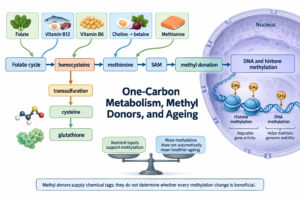
The epigenome refers to chemical and structural features that regulate how DNA is used without changing the underlying DNA-letter sequence.
AKG provides one route through which cellular metabolic state can alter epigenetic enzyme activity. This occurs because TET enzymes and many histone demethylases require AKG as part of their catalytic reaction. (Review)
DNA methylation
DNA methylation usually refers to attachment of a methyl chemical group to cytosine, frequently at DNA sites in which cytosine is followed by guanine. These are called CpG sites.
Methylation can influence gene regulation, but its meaning depends on where in the genome the mark occurs. “More methylation” is not uniformly old or harmful, and “less methylation” is not uniformly young or beneficial.
TET enzymes
TET stands for ten-eleven translocation. The three mammalian proteins are TET1, TET2 and TET3.
TET enzymes oxidize 5-methylcytosine (5mC) into intermediates including 5-hydroxymethylcytosine (5hmC). Through additional biochemical steps and DNA-repair processes, this can contribute to restoration of unmethylated cytosine. (Review)
AKG is required for this chemistry.
However:
AKG availability → TET chemistry
does not automatically mean:
AKG supplement → removal of harmful ageing methylation → rejuvenation.
TET proteins must still be present, active and recruited to particular genomic regions.
Histone demethylation
DNA is wrapped around proteins called histones. Histones can carry methyl groups at specific amino-acid positions.
Many enzymes containing a Jumonji C, or JmjC, domain can remove selected histone methyl marks. Their catalytic reaction requires AKG and ferrous iron. (Review)
Individual histone marks have different biological meanings. Removing a repressive methyl mark may promote gene activity, whereas removing an activating mark may reduce it. Consequently, “histone demethylation” by itself should not be equated with rejuvenation.
AKG versus succinate and fumarate
AKG-dependent dioxygenases generate succinate during their reactions. Under some metabolic conditions, elevated succinate or fumarate can also compete with AKG and inhibit this enzyme family. (Research)
This observation has led researchers to examine metabolite ratios—for example, succinate relative to AKG—rather than thinking of AKG as an isolated switch.
The strongest experimental evidence for dramatic succinate/fumarate effects comes from cellular and cancer-related metabolic contexts and should not be generalized to ordinary dietary fluctuations.
2-hydroxyglutarate
2-hydroxyglutarate (2-HG) is chemically similar enough to AKG to interfere with several AKG-dependent enzymes. It is particularly important in cancers carrying certain IDH mutations, in which abnormal 2-HG accumulation can produce widespread epigenetic effects. (Review)
This is useful mechanistic evidence that metabolite chemistry can reshape the epigenome, but it is not evidence that supplemental AKG can precisely reverse ageing-associated methylation.
Oxygen sensing
Not all AKG-dependent dioxygenases are epigenetic enzymes.
Prolyl hydroxylases use AKG while regulating proteins involved in the cellular response to oxygen, including hypoxia-inducible factors. (Review)
Thus, changing AKG availability potentially intersects with oxygen sensing as well as epigenetic regulation.
Collagen biology
Other members of the enzyme family hydroxylate collagen-related proteins. AKG therefore connects to extracellular-matrix and connective-tissue biology through mechanisms distinct from TET-mediated DNA demethylation.
This distinction matters when interpreting skin or bone studies: a clinical change in skin firmness or a bone-turnover marker does not demonstrate DNA demethylation.
AKG versus direct epigenetic engineering
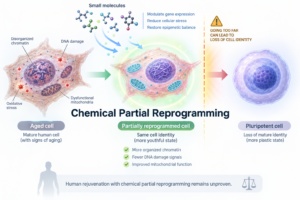
Targeted CRISPR–dCas9 epigenome systems can be designed to bring a methylating, demethylating or chromatin-modifying enzyme toward a chosen DNA region.
AKG cannot perform that targeting.
It changes the metabolic environment in which many enzymes operate simultaneously.
The scientifically appropriate classification is:
AKG = broad metabolic support for multiple enzyme families
not:
AKG = targeted DNA-demethylation therapy.
Symptoms, Patterns, and Differential Clues
There is no symptom pattern that diagnoses low AKG, impaired TET activity or deficient histone demethylation in otherwise healthy adults.
Fatigue, reduced physical performance, cognitive changes, altered bone density, slow wound healing and visible skin ageing can arise from numerous unrelated biological processes. None can identify AKG-dependent epigenetic dysfunction from symptoms.
Human AKG studies therefore use predefined research measurements rather than symptom-based diagnosis. These include DNA-methylation-age estimates, bone-turnover biomarkers, bone mineral density, exercise performance, wound healing, nutritional markers and local skin measurements.
A useful hierarchy is:
metabolite measurement → did AKG-related metabolism change?
epigenetic measurement → did DNA or histone chemistry change?
biological-age biomarker → did a statistical ageing measure change?
functional outcome → did strength, cognition or another function change?
clinical outcome → did disease burden change?
longevity outcome → did survival change?
Evidence at one level should not automatically be described as evidence at the next.
Evaluation & Diagnosis (Clinical Context)
Research evaluation of the AKG pathway can involve plasma or tissue metabolomics, enzyme assays, DNA-methylation profiling, histone-mark analysis, RNA sequencing and functional outcomes.
A DNA-methylation clock estimates an age-related biological characteristic from methylation at selected DNA sites. Such clocks can be valuable research tools, but they are not direct measurements of how old every organ is.
The most widely cited human CaAKG ageing study measured methylation age before and after a CaAKG-plus-vitamin formulation in 42 people and reported a substantial average decline. Because there was no concurrent placebo group and the formulation contained additional vitamins, the result is hypothesis-generating rather than proof that CaAKG reversed ageing. (Research)
A 2026 cross-sectional study found that users of a delayed-release CaAKG-plus-vitamin formulation had a lower biological-age residual in an exceptionally healthy cohort. Cross-sectional associations can be influenced by differences between supplement users and nonusers and cannot establish treatment causality. (Research)
The ABLE study was designed to address part of this evidence gap using randomized placebo-controlled CaAKG exposure and DNA-methylation-age outcomes in middle-aged adults. (Research, Authority)
Treatment Options Snapshot (Evidence-Graded, Descriptive Only)
Supplements / Vitamins (Research Context Only)
Available direct human supplement evidence was more limited than the evidence available for standard medical treatment categories in this condition.
Tier A — Strong / Moderate Evidence
No supplement met Strong or Moderate criteria for human epigenetic rejuvenation through the AKG–TET/Jumonji axis.
Tier B — Limited-Mixed Evidence
- Calcium alpha-ketoglutarate plus vitamins — A retrospective before/after study in 42 adults taking a CaAKG-containing combination measured a DNA-methylation-age estimate and reported a substantial average reduction. The findings are mixed in interpretability because there was no placebo group, the preparation contained additional vitamins, and the methylation-clock result was not accompanied by evidence of longer survival or broad clinical rejuvenation. Evidence: Limited-Mixed. (Research)
- Arginine alpha-ketoglutarate — Controlled studies in physically active or resistance-trained men measured peak power, strength, plasma arginine, nitric-oxide metabolites and blood flow. Findings were inconsistent across trials, and one randomized study found that the haemodynamic and nitric-oxide changes were attributable to exercise rather than AAKG; none established an epigenetic ageing effect. Evidence: Limited-Mixed. (Research, Research)
- Ornithine alpha-ketoglutarate — Randomized studies in adults with severe burns evaluated wound-healing and nutritional recovery measures. Findings belong to a highly catabolic medical population, and applicability to healthy ageing or epigenetic demethylation is uncertain. Evidence: Limited-Mixed. (Research, Research)
Tier C — Emerging Evidence
- Delayed-release CaAKG plus vitamins — A 2026 cross-sectional analysis in an exceptionally healthy cohort found that users of this combination had a lower biological-age residual on average. The evidence is early-stage because exposure was observational rather than randomized and the formulation contained more than CaAKG. Evidence: Emerging. (Research)
- Calcium alpha-ketoglutarate — A six-month study in postmenopausal women with osteopenia measured serum C-terminal telopeptide of type I collagen (CTX) and bone mineral density. CTX differed between groups, while the between-group BMD difference was not statistically significant; the study addresses bone metabolism rather than TET activation or epigenetic ageing. Evidence: Emerging. (Research)
- AKG-supplemented enteral nutrition — Small human studies around abdominal surgery have evaluated AKG-enriched enteral feeding using nitrogen, amino-acid and clinical-nutrition measurements. The evidence is early-stage and population-specific, and the perioperative metabolic effects cannot be generalized to healthy longevity. Evidence: Emerging. (Research)
- Creatine plus AAKG multi-ingredient preparations — Exercise research in young men measured bench-press repetitions and Wingate peak power after a formulation containing creatine, AAKG and additional nutrients. Because several active ingredients were combined, the effect cannot be assigned to AKG and has no direct epigenetic-age endpoint. Evidence: Emerging. (Research)
- Sustained-release CaAKG in the ABLE research program — The randomized double-blind ABLE study was designed to measure change in DNA-methylation age in middle-aged adults receiving CaAKG or placebo. A registered protocol establishes that this question is being tested prospectively; it does not by itself establish efficacy. Evidence: Emerging. (Research, Authority)
Topical / Cosmetic Ingredients (Research Context Only)
Available direct human topical/local evidence was limited for this condition.
- AKG-containing fermented-rice cosmetic formulation — Human facial-skin testing evaluated a cream containing AKG-rich fermented-rice material and measured wrinkle scores, firmness, gloss and other skin characteristics over several weeks. The evidence is early-stage and formulation-specific, and it cannot establish that pure topical AKG activates TET enzymes or reverses skin epigenetic age. Evidence: Emerging. (Research)
Dietary Sources (Research Context Only)
No dietary sources met strict human-evidence inclusion criteria for this condition.
Direct human dietary-source evidence was narrower than the target item count.
Glutamine, glutamate and other dietary amino acids participate in metabolic networks capable of generating AKG, but this metabolic relationship is not equivalent to a controlled human demonstration that a particular food raises relevant tissue AKG sufficiently to alter TET or histone-demethylase activity. (Review)
This distinction prevents food composition from being mistaken for an anti-ageing intervention.
What Research Has Studied
- TET-mediated DNA chemistry: studies examine how AKG availability influences TET-dependent oxidation of 5-methylcytosine and broader DNA-demethylation pathways. (Review)
- Histone demethylation: JmjC-domain enzymes are studied structurally and biochemically to understand how AKG and Fe²⁺ permit removal of selected histone methyl marks. (Review)
- Metabolite competition: succinate, fumarate and 2-HG are studied as antagonists of AKG-dependent dioxygenases. (Research)
- DNA-methylation-age biomarkers: CaAKG-containing formulations have been studied using epigenetic-age estimates in observational or uncontrolled human designs. (Research, Research)
- Randomized human geroscience: the ABLE research program was designed to test CaAKG prospectively against DNA-methylation-age and related outcomes. (Research)
- Animal longevity: one mouse study found longer lifespan and compressed morbidity, while later genetically heterogeneous mouse work did not reproduce lifespan extension. (Research, Research)
- Bone metabolism: CaAKG has been studied in postmenopausal osteopenia using CTX and BMD. (Research)
- Catabolic and exercise states: AAKG and OKG have been investigated in exercise, severe burns and surgery using performance, wound-healing and nutrition outcomes. (Research, Research)
- Local skin effects: an AKG-containing cosmetic formulation has been studied using wrinkle and skin-quality measures. (Research)
Frequently searched candidates evaluated but not admitted as equivalent interventions
Vitamin C is relevant because it can support the activity of several Fe²⁺/AKG-dependent dioxygenases. This makes vitamin C mechanistically connected to TET and Jumonji chemistry, but it does not establish that vitamin-C supplementation reproduces CaAKG’s metabolic role or causes human epigenetic rejuvenation. (Review)
Iron is also required by these enzymes. Iron availability can therefore affect catalytic activity, but more iron is not synonymous with more beneficial demethylation and iron supplementation should not be classified as an AKG intervention. (Review)
Glutamine and glutamate were evaluated because cells can derive AKG through amino-acid metabolism. A biochemical precursor relationship does not demonstrate that consuming either compound produces the same tissue exposure or epigenetic outcome as CaAKG. (Review)
Succinate was evaluated because it is a TCA-cycle neighbour and a reaction product of AKG-dependent dioxygenases. Experimental work shows that elevated succinate can instead competitively inhibit several AKG-dependent enzymes, making it mechanistically different from an AKG supplement. (Research)
Fumarate was evaluated for the same reason. In experimental systems, elevated fumarate can inhibit AKG-dependent DNA and histone demethylases rather than substitute for AKG. (Research)
2-hydroxyglutarate resembles AKG chemically but can inhibit AKG-dependent dioxygenases. It is particularly relevant to abnormal cancer metabolism and should not be interpreted as a useful AKG analogue. (Review)
NMN and NR were evaluated because NAD⁺ metabolism also connects metabolism to epigenetic regulation. Their primary chromatin connection is through NAD-dependent sirtuins, not through the TET/Jumonji co-substrate mechanism.
Sodium butyrate was evaluated because it directly affects chromatin, but principally through inhibition of conventional histone deacetylases. Histone acetylation and AKG-dependent methylation are separate epigenetic axes.
Spermidine was evaluated because it is prominent in geroscience, but its principal experimental rationale concerns autophagy and proteostasis rather than direct AKG-dependent demethylation.
Fisetin and quercetin were evaluated because of senescence research. Neither should be described as an established human TET activator or AKG substitute.
Resveratrol was evaluated because it is commonly linked to epigenetics through sirtuin biology. This is an NAD-related deacetylation pathway rather than AKG-dependent demethylation.
Metformin and berberine can alter cellular metabolism and signalling, but no qualifying human evidence establishes that their ageing-related effects operate through clinically meaningful AKG-driven TET or Jumonji activation.
Taurine, GlyNAC and urolithin A were also evaluated because they appear frequently in longevity research. Their main human research axes—metabolism/redox biology or mitophagy—are distinct from direct AKG-dependent demethylation.
The broader lesson is that two compounds can both be “epigenetically relevant” without sharing the same epigenetic mechanism.
Safety, Interactions & Regulatory Context
AKG is endogenous—that is, the human body makes it naturally—but endogenous status does not prove that long-term supplemental exposure is beneficial or risk-free.
The form of supplementation matters. Calcium-AKG also provides calcium. Arginine-AKG delivers arginine. Ornithine-AKG delivers ornithine. Findings from these salts can reflect their accompanying component as well as AKG.
Most human AKG studies are not long-term geroscience trials. They include relatively short studies in exercise, severe burns, surgery, osteopenia or observational longevity cohorts. This limits conclusions about chronic exposure in otherwise healthy middle-aged or older adults. (Review)
The epigenetic mechanism itself also argues against a simple “more is better” interpretation. TET proteins and Jumonji enzymes regulate large numbers of genomic sites, while other AKG-dependent dioxygenases influence oxygen sensing and collagen biology. Increasing substrate availability cannot be assumed to produce only favourable changes.
In the United States, FDA does not approve dietary supplements for safety and effectiveness before they are marketed in the way it approves drugs. (FDA)
Evidence Overview
AKG occupies an unusually strong mechanistic position in epigenetic biology. It is not merely correlated with methylation enzymes: it is chemically required by TET proteins and numerous JmjC-domain histone demethylases. (Review)
That makes the pathway scientifically important.
It does not make human rejuvenation established.
The human evidence is currently dominated by three different categories that should not be merged. First, an uncontrolled combination study reported a substantial change in a DNA-methylation-age estimate. Second, a 2026 observational cohort reported a smaller association with a biological-age measure. Third, prospective randomized research has been designed to test CaAKG more rigorously. (Research, Research, Research)
None of those findings establishes that CaAKG selectively removes undesirable age-associated methyl groups.
The preclinical longevity story is also mixed. A 2020 mouse study reported CaAKG-associated lifespan extension, reduced inflammatory cytokines and compressed morbidity. A 2026 Intervention Testing Program study in genetically heterogeneous mice did not reproduce lifespan extension. (Research, Research)
This contradiction is scientifically useful. It suggests that AKG effects may depend on strain, sex, formulation, experimental context or other variables, and it reduces confidence in treating one positive animal experiment as settled longevity evidence.
The older human literature provides another important boundary. CaAKG, AAKG and OKG have measurable effects in certain bone, exercise, wound-healing and nutrition studies, demonstrating that AKG salts can participate in human physiology. These results do not demonstrate TET activation, epigenetic-clock reversal or longevity.
The most defensible conclusion is therefore:
AKG has a well-established biochemical role in epigenetic demethylation enzymes, but supplemental AKG remains an emerging human geroscience intervention rather than a demonstrated epigenetic rejuvenation therapy.
Evidence Confidence Classification
Overall Rating: Emerging
Mechanistic confidence is high that AKG is required for TET and many Jumonji-domain demethylation reactions. Clinical confidence is substantially lower because human ageing studies are small, observational, uncontrolled, combination-formulation based or still being prospectively tested, while even mouse lifespan evidence is now mixed. (Review, Research, Research)
What Does Not (Evidence Gaps)
- AKG as a selective “demethylation supplement” — TET and JmjC enzymes require AKG, but supplemental AKG cannot be directed toward only harmful age-associated methylation sites. Human locus-specific rejuvenation has not been established. (Review)
- The “eight-year age reversal” claim — The often-cited result describes an average change in a DNA-methylation-age estimate after an uncontrolled CaAKG-plus-vitamin intervention. It should not be translated into eight additional years of life, an eight-year reduction in organ age, or proof of CaAKG efficacy by itself. (Research)
- AKG as a proven lifespan-extending compound — One mouse study was positive, but a later genetically heterogeneous mouse test did not reproduce lifespan extension, and human survival has not been demonstrated. (Research, Research)
- Glutamine, vitamin C or iron as substitutes for AKG — Each intersects AKG-dependent enzyme biology differently, but none is chemically or clinically equivalent to AKG. Mechanistic overlap is not evidence of interchangeable rejuvenation effects. (Review)
- AKG-rich or glutamine-rich foods as proven epigenetic therapies — This evidence screen did not identify controlled whole-food studies demonstrating AKG-driven human DNA or histone demethylation. Normal metabolic conversion should not be converted into a treatment claim. (Review)
FAQ
1. What is alpha-ketoglutarate?
Alpha-ketoglutarate is a normal metabolite involved in mitochondrial energy metabolism, amino-acid metabolism and the chemistry of multiple enzyme families. It is also called AKG or 2-oxoglutarate. (Review)
2. Why is AKG considered epigenetically relevant?
Several enzymes that alter DNA and histone methylation require AKG as a co-substrate. These include TET DNA-modifying enzymes and many Jumonji-domain histone demethylases. (Review, Review)
3. What is DNA methylation?
DNA methylation is a chemical modification in which a methyl group is attached to DNA, commonly to cytosines at CpG sites. Its regulatory effect depends on genomic location, so methylation cannot be classified universally as good, bad, young or old.
4. What is a TET enzyme?
TET1, TET2 and TET3 are enzymes that oxidize methylated cytosine and participate in DNA-demethylation pathways. Their catalytic chemistry requires AKG, oxygen and iron. (Review)
5. Does AKG itself remove methyl groups from DNA?
No. AKG supplies a molecule required by the enzyme reaction. TET proteins perform the DNA chemistry and are targeted through cellular regulatory mechanisms.
6. What is histone demethylation?
Histone demethylation is removal of methyl groups from selected positions on histone proteins. Many JmjC-domain demethylases perform this reaction using AKG and Fe²⁺. (Review)
7. Does demethylation make cells younger?
Not automatically. Different methyl marks have different biological roles, and removing the wrong mark could have a very different effect from removing another. No general rule equates more demethylation with rejuvenation.
8. What is calcium alpha-ketoglutarate?
CaAKG is the calcium salt of AKG. It is the form used in several prominent human and animal ageing studies, but evidence from CaAKG should not be assigned automatically to AAKG, OKG or free AKG.
9. What is the AKG–succinate relationship?
AKG-dependent dioxygenases generate succinate during their reactions. Experimental evidence also shows that elevated succinate can competitively inhibit several of these enzymes. (Research)
10. Why is fumarate discussed with AKG?
Fumarate is another TCA-cycle-related metabolite that can inhibit AKG-dependent DNA and histone demethylases under experimental conditions. This demonstrates that metabolic ratios can influence epigenetic enzyme activity. (Research)
11. Did a human study really show an eight-year reduction in biological age?
A study of 42 adults reported an average decline of about eight years on a DNA-methylation-age estimate after a CaAKG-plus-vitamin formulation. Because the study lacked a placebo group and used a combination, it does not prove that CaAKG reversed human physiology by eight years. (Research)
12. Is there newer human evidence?
A 2026 observational cohort found an association between a delayed-release CaAKG-plus-vitamin formulation and a lower biological-age residual. Because users were not randomly assigned, the finding remains associative rather than proof of treatment efficacy. (Research)
13. Is CaAKG being tested in a randomized trial?
The ABLE study was designed as a randomized double-blind placebo-controlled trial examining sustained-release CaAKG and DNA-methylation-age outcomes in middle-aged adults. The registered trial addresses a major evidence gap because earlier human ageing evidence was not placebo-controlled. (Research, Authority)
14. Does AKG extend lifespan in mice?
The answer is currently mixed. A 2020 study reported longer lifespan and compressed morbidity, whereas a 2026 study in genetically heterogeneous UM-HET3 mice did not find lifespan extension from alpha-ketoglutarate. (Research, Research)
15. Does AKG extend human lifespan?
No controlled human evidence demonstrates human lifespan extension from AKG.
16. Is AKG basically the same as NMN?
No. NMN feeds into NAD⁺ metabolism and therefore intersects with NAD-dependent sirtuins. AKG is a co-substrate for a different enzyme family that includes TET proteins and Jumonji demethylases.
17. Is AKG basically the same as sodium butyrate?
No. Sodium butyrate primarily influences chromatin through inhibition of conventional histone deacetylases. AKG principally connects to DNA and histone demethylation through α-KG-dependent dioxygenases.
18. Can dietary protein or glutamine replace CaAKG?
Protein, glutamine and glutamate participate in metabolic pathways that can generate AKG, but that does not demonstrate equivalence to CaAKG supplementation. No qualifying whole-food evidence in this review established clinically meaningful AKG-driven epigenetic demethylation. (Review)
19. Has topical AKG been studied?
A human study evaluated a cosmetic formulation containing AKG-rich fermented-rice material and reported changes in several facial-skin measurements. The formulation was complex, so the results cannot establish that isolated topical AKG produces the same outcomes or changes skin epigenetic age. (Research)
20. What would stronger evidence require?
The field needs replicated randomized trials of clearly defined AKG preparations, longer follow-up, independent laboratories, multiple ageing biomarkers, clinically meaningful functional outcomes and evidence that biomarker changes predict better health rather than simply changing a molecular measurement.
Resources
Metabolic Coordination of Cell Fate by α-Ketoglutarate-Dependent Dioxygenases — Review — https://pubmed.ncbi.nlm.nih.gov/33092942/
Inhibition of α-KG-Dependent Histone and DNA Demethylases by Fumarate and Succinate — Research — https://pubmed.ncbi.nlm.nih.gov/22677546/
Structural Insights into Histone Lysine Demethylation — Review — https://pubmed.ncbi.nlm.nih.gov/20970991/
Alpha-Ketoglutarate Dietary Supplementation to Improve Health in Humans — Review — https://pubmed.ncbi.nlm.nih.gov/34952764/
CaAKG-Plus-Vitamin Formulation and DNA-Methylation Age — Research — https://pubmed.ncbi.nlm.nih.gov/34847066/
Supplements and Drugs Associated With Biological Age in an Exceptionally Healthy Cohort — Research — https://pubmed.ncbi.nlm.nih.gov/42166733/
Alpha-Ketoglutarate Supplementation and Biological Age: ABLE Protocol — Research — https://pubmed.ncbi.nlm.nih.gov/37217632/
ABLE Clinical Trial Record — Authority — https://clinicaltrials.gov/study/NCT05706389
Alpha-Ketoglutarate Extends Lifespan and Compresses Morbidity in Ageing Mice — Research — https://pubmed.ncbi.nlm.nih.gov/32877690/
Intervention Testing Program: Alpha-Ketoglutarate and Lifespan in UM-HET3 Mice — Research — https://pubmed.ncbi.nlm.nih.gov/41843349/
Calcium Alpha-Ketoglutarate in Postmenopausal Osteopenia — Research — https://pubmed.ncbi.nlm.nih.gov/17896582/
Arginine Alpha-Ketoglutarate: Pharmacokinetics, Safety and Exercise Performance — Research — https://pubmed.ncbi.nlm.nih.gov/16928472/
AAKG, Blood Flow and Nitric-Oxide Metabolites After Resistance Exercise — Research — https://pubmed.ncbi.nlm.nih.gov/21813912/
Ornithine Alpha-Ketoglutarate and Wound Healing in Severe Burns — Research — https://pubmed.ncbi.nlm.nih.gov/10890617/
Nutritional and Clinical Efficacy of Ornithine Alpha-Ketoglutarate in Severe Burns — Research — https://pubmed.ncbi.nlm.nih.gov/10601539/
Alpha-Ketoglutarate-Supplemented Enteral Nutrition Around Abdominal Surgery — Research — https://pubmed.ncbi.nlm.nih.gov/12297206/
Creatine, AAKG and Exercise Performance — Research — https://pubmed.ncbi.nlm.nih.gov/19033611/
AKG-Containing Cosmetic Cream and Human Skin Outcomes — Research — https://pubmed.ncbi.nlm.nih.gov/34817909/
FDA Questions and Answers on Dietary Supplements — FDA — https://www.fda.gov/food/information-consumers-using-dietary-supplements/questions-and-answers-dietary-supplements
More from the Medical & Health Conditions Encyclopedia