

Introduction
Partial cellular reprogramming is an experimental approach intended to shift an older or damaged cell towards a younger regulatory state without converting it fully into a pluripotent stem cell. It usually involves temporary, cyclic, tissue-restricted or otherwise controlled exposure to reprogramming factors such as OCT4, SOX2, KLF4 and MYC. These four factors are collectively called OSKM or the Yamanaka factors. (Review, Review)
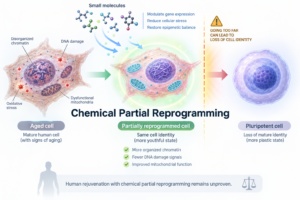
Full reprogramming can erase a mature cell’s identity and return it to a stem-cell-like state. Partial reprogramming attempts to stop earlier, after selected ageing-associated molecular features have changed but before the cell forgets whether it is a skin cell, nerve cell, muscle cell or another specialised cell type. Whether that safe and useful window can be controlled reliably remains one of the field’s central questions. (Review, Research)
Research includes cyclic OSKM expression, OSK systems that omit MYC, transient messenger-RNA delivery, tissue-specific gene therapy and chemical combinations intended to reproduce selected parts of the reprogramming process. Supplements such as NMN, alpha-ketoglutarate, sodium butyrate and spermidine may affect pathways connected to chromatin or cellular ageing, but they have not demonstrated partial cellular reprogramming in humans. (Review, Research)
A first-in-human Phase 1 study is evaluating a localized investigational OSK-based therapy in adults with open-angle glaucoma or non-arteritic anterior ischemic optic neuropathy. Its central purpose is to assess safety and tolerability, not whole-body age reversal. (Research)
Informational only; no medical, dosing, or emergency instructions.
Quick Summary
- Partial cellular reprogramming uses restricted reprogramming-factor exposure in an attempt to alter age-associated cellular features without completing the transition to pluripotency. (Review)
- OSKM refers to OCT4, SOX2, KLF4 and MYC; OSK omits MYC. (Review)
- A cell’s identity is the stable gene-regulatory programme that makes it a nerve, muscle, liver, skin or other specialised cell. (Review)
- Human-cell experiments have reported changes in DNA-methylation age and gene-expression patterns after transient reprogramming-factor exposure. (Research, Research)
- Mouse studies have reported changes in tissue regeneration, methylation patterns, frailty measures and survival-related outcomes. (Research, Research)
- Longer or poorly controlled systemic reprogramming can cause severe liver and intestinal toxicity in animal models. (Research)
- OSK expression has produced regeneration-related findings in mouse optic-nerve research, helping motivate localized human translation. (Research, Research)
- Chemical reprogramming uses multi-compound laboratory cocktails; it is not equivalent to taking one supplement. (Research, Research)
- No supplement, food or cosmetic ingredient has demonstrated controlled partial cellular reprogramming in humans.
- Overall evidence is Emerging because experimental findings are substantial but human efficacy data are not yet available. (Review, Research)
What It Is (Clinical Definition & Classification)
Partial cellular reprogramming is the controlled activation of reprogramming pathways for a duration, frequency or location intended to change age-associated cellular features while retaining mature cell identity. It differs from full induced-pluripotent-stem-cell reprogramming, which deliberately erases specialised identity. (Review, Review)
A pluripotent cell is capable of producing many different cell types. Full reprogramming can convert a specialised adult cell into an induced pluripotent stem cell, abbreviated iPSC. Partial reprogramming attempts to stop before that endpoint. (Review)
Cyclic reprogramming
Cyclic protocols repeatedly switch OSKM expression on and off. The off-period is intended to allow the cell to stabilise and retain its mature identity before another limited exposure. The first influential in-vivo ageing study used repeated short cycles in mice. (Research)
Transient reprogramming
Transient protocols expose cells to reprogramming factors for a limited continuous period and then withdraw them. Human-cell studies have used non-integrating messenger RNA or carefully timed factor expression to avoid permanent insertion of reprogramming genes into DNA. (Research, Research)
Tissue-specific reprogramming
Tissue-specific systems attempt to limit factor activity to a selected organ or cell type. This can reduce exposure in vulnerable organs and may allow disease-specific translation, as illustrated by retinal and optic-nerve research. (Research, Research)
Targeted cell-state reprogramming
Targeted systems attempt to activate reprogramming only in cells with particular stress, ageing or senescence-associated signals. This remains a preclinical strategy intended to avoid unnecessary reprogramming of healthier cells. (Review)
Chemical partial reprogramming
Chemical partial reprogramming uses combinations of small molecules that affect chromatin enzymes, developmental pathways or cell signalling. The evidence concerns complete laboratory cocktails rather than proof that one ingredient can reproduce the result alone. (Research, Research)
Why It Happens (Causes & Risk Factors)
Ageing cells accumulate changes in DNA methylation, chromatin organisation, gene expression, mitochondrial function and stress responses. Partial reprogramming research tests whether some of these changes are reversible regulatory states rather than permanent damage. (Review)
The rationale comes partly from full reprogramming. When an adult cell is converted into an iPSC, many molecular measurements associated with cellular age become younger. The challenge is to retain selected restorative effects without erasing mature identity or creating uncontrolled growth. (Review)
Not every ageing-associated change is necessarily harmful or reversible. Some may represent protective adaptations, accumulated physical damage or changes caused by the surrounding tissue environment. Reprogramming one molecular layer may therefore fail to correct DNA mutations, extracellular-matrix damage or other ageing processes. (Review)
The response also differs among tissues. Liver cells, intestinal cells, retinal neurons, muscle cells and brain cells have different identity programmes, regenerative capacities and tolerance for temporary dedifferentiation. Animal studies have reported both beneficial and severely harmful outcomes depending on tissue and exposure design. (Research, Research)
Mechanisms / Pathophysiology
In plain language, partial reprogramming temporarily loosens parts of the regulatory system that keep a mature cell locked into its current state. Researchers hope that the cell can repair or reorganise some ageing-associated patterns before its identity becomes unstable. (Review)
Yamanaka factors
OCT4, SOX2, KLF4 and MYC are transcription factors. A transcription factor is a protein that binds DNA or regulatory regions and changes the activity of many genes. Together, OSKM can initiate the broad gene-regulatory changes required for pluripotency. (Review)
MYC promotes growth, metabolism and proliferation and is associated with cancer biology. OSK systems omit MYC to reduce one source of risk, but OCT4, SOX2 and KLF4 can still disrupt identity or produce unwanted tissue effects. (Review)
Initiation, maturation and pluripotency
Reprogramming is commonly described as progressing through stages. During the early initiation phase, cells begin changing metabolism, gene expression and chromatin accessibility. During later stages, they progressively suppress mature-cell programmes and activate pluripotency networks. (Research, Research)
Partial reprogramming attempts to use part of this process without reaching full pluripotency. Human-fibroblast research found that DNA-methylation-age estimates began declining before complete loss of somatic identity, suggesting a possible intervention window. A somatic cell is any ordinary body cell other than a reproductive cell. (Research)
DNA methylation and epigenetic age
DNA methylation is the attachment of small methyl groups to DNA. Epigenetic clocks use patterns at selected methylation sites to estimate age or age-related risk. A younger clock result means that the measured pattern more closely resembles the model’s younger reference data; it does not by itself prove restored function. (Research, Review)
Transient reprogramming studies in human cells have reported reductions in some methylation-age estimates after factor withdrawal. These experiments were performed in cultured cells and do not establish that equivalent changes can be achieved safely throughout a person’s body. (Research)
Transcriptomic rejuvenation
The transcriptome is the collection of RNA molecules being produced by a cell and therefore indicates which genes are active. A transcriptomic-age clock compares gene-expression patterns with reference patterns from younger and older cells. (Research, Research)
Transient factor expression and chemical cocktails have produced younger transcriptomic estimates in cultured human cells. Such changes are molecular outcomes and should not be described as clinical rejuvenation without evidence of durable tissue function and safety. (Research, Research)
Chromatin remodelling
Chromatin is DNA together with its packaging and regulatory proteins. Reprogramming factors bind regulatory regions and alter which areas of chromatin are accessible. Early changes may suppress parts of the mature-cell programme before complete pluripotency genes are activated. (Review)
This temporary weakening of cell identity may permit restorative changes, but it also creates risk. A cell that no longer reliably follows its specialised programme may function poorly, proliferate abnormally or contribute to organ failure. (Research)
Mitochondrial and stress-response changes
Human-cell studies have reported changes in mitochondrial measures, inflammatory gene expression and cellular stress responses after transient reprogramming-factor exposure. These findings are cellular observations rather than evidence of improved health outcomes in people. (Research)
Chemical reprogramming mechanisms
Chemical cocktails can contain compounds that alter histone acetylation, developmental signalling, DNA or histone methylation and cell-cycle pathways. Sinclair and colleagues reported six combinations that changed transcriptomic-age and nucleocytoplasmic-compartmentalisation measurements in cultured cells. (Research)
Nucleocytoplasmic compartmentalisation describes how effectively a cell keeps nuclear molecules in the nucleus and cytoplasmic molecules outside it. Ageing and cellular stress can disrupt this separation, making it useful as a laboratory cell-function measurement. (Research)
A separate 2025 study used a seven-compound chemical cocktail in aged human fibroblasts and reported changes in DNA damage, heterochromatin, senescence and oxidative-stress markers. A fibroblast is a connective-tissue cell commonly used in laboratory ageing studies. These findings remain cultured-cell evidence. (Research)
Symptoms, Patterns, and Differential Clues
Partial cellular reprogramming is a research intervention rather than a symptom-defined disease. There is no clinical symptom pattern that indicates a person needs reprogramming and no validated test that identifies suitable candidates for general anti-ageing treatment. (Review)
Researchers instead examine molecular and cellular patterns such as:
- DNA-methylation age
- transcriptomic age
- retained cell identity
- senescence markers
- chromatin organisation
- mitochondrial measurements
- inflammatory gene expression
- tissue regeneration
- tumour or abnormal-growth signals
These outcomes are not interchangeable. A lower epigenetic age does not necessarily mean better tissue function, while improved regeneration does not prove that every molecular feature became younger. (Review)
The main differential distinction is between rejuvenation and dedifferentiation. Rejuvenation implies restoration of useful youthful characteristics while identity and function are preserved. Dedifferentiation means that a specialised cell begins losing the programme that defines what it is. (Review)
Evaluation & Diagnosis (Clinical Context)
There is no established clinical diagnostic pathway for partial cellular reprogramming. Current evaluation occurs in laboratory research, animal studies and an early localized Phase 1 trial. (Research)
A credible reprogramming study should evaluate several evidence layers:
- Did the intended reprogramming factors reach the target cells?
- Did age-associated molecular markers change?
- Was mature cell identity retained?
- Did tissue function improve?
- Did the effect persist after factor withdrawal?
- Were abnormal growth, organ toxicity or tumours observed?
- Did the intervention improve disease or survival outcomes?
Methylation clocks should be interpreted alongside functional outcomes because molecular-age changes may occur before identity loss and may also be influenced by experimental design. (Research, Review)
The ER-100 trial evaluates a localized ocular intervention, making visual function, ocular safety and long-term adverse events more relevant than whole-body ageing clocks. The registered follow-up includes extended safety observation because delayed effects are an important concern for gene-based interventions. (Research)
Treatment Options Snapshot (Evidence-Graded, Descriptive Only)
Procedures / Devices / Technologies
- Cyclic OSKM expression — A foundational mouse study used repeated short OSKM cycles and measured survival in a progeroid model, tissue responses and ageing-associated molecular features. Findings were model-specific and do not establish human safety or lifespan extension. Evidence: Emerging. (Research)
- Longer-term partial OSKM protocols — Research in physiologically ageing mice evaluated different starting ages and durations and reported changes in skin, kidney, transcriptomic and epigenetic measures. Longer exposure produced stronger molecular findings in some tissues but cannot be generalised beyond the studied mouse system. Evidence: Emerging. (Research)
- Transient messenger-RNA reprogramming — Human-cell research used non-integrating messenger RNA to express reprogramming factors temporarily and measured gene expression, inflammatory markers, mitochondrial measures and cellular function. The experiments involved cultured cells rather than clinical treatment. Evidence: Emerging. (Research)
- Maturation-phase transient reprogramming — Human fibroblasts were exposed to reprogramming factors during a defined early-to-middle phase and then returned to normal culture. Reported outcomes included DNA-methylation age and transcriptomic changes, but tissue function and human safety were not tested. Evidence: Emerging. (Research)
- OSK optic-nerve reprogramming — Mouse research used OCT4, SOX2 and KLF4 and reported changes in axon regeneration, DNA-methylation patterns and selected visual outcomes. Translation is now limited to an early localized human safety study, with no published efficacy findings. Evidence: Emerging. (Research, Research)
- AAV-mediated systemic OSK — Aged-mouse research used an inducible gene-delivery system and reported changes in remaining lifespan, frailty measures and methylation age. The study was preclinical, and systemic gene delivery creates major translation and safety questions. Evidence: Emerging. (Research)
- Chemical partial reprogramming — Multi-compound cocktails have changed transcriptomic-age and cellular-function measurements in cultured human cells. The mixtures contained several pharmacologically active or experimental compounds and have not been tested as human anti-ageing treatments. Evidence: Emerging. (Research, Research)
Supplements / Vitamins (Research Context Only)
No supplements met strict human-evidence inclusion criteria for partial cellular reprogramming.
Frequently searched candidates are listed below because their absence from the qualifying treatment section is itself important.
- NMN and nicotinamide riboside — These NAD⁺ precursors are studied for metabolic and ageing-related biomarkers, but no human study has demonstrated partial cellular reprogramming or controlled resetting of cell identity. Their pathway relevance does not make them substitutes for OSK, OSKM or a complete chemical cocktail. Evidence: Emerging for related ageing biology; no qualifying reprogramming evidence. (Review)
- Alpha-ketoglutarate — AKG is a metabolic cofactor connected to DNA- and histone-demethylating enzymes and has appeared in chemical-reprogramming research contexts. No human trial has demonstrated partial cell-state reprogramming from AKG supplementation. Evidence: Emerging for related epigenetic biology; no qualifying reprogramming evidence. (Research)
- Sodium butyrate — Sodium butyrate inhibits histone deacetylases and was studied as a component or enhancer within chemical-reprogramming experiments. Its presence in a multi-compound cell-culture system does not establish that oral sodium butyrate produces human partial reprogramming. Evidence: Cellular for cocktail use; no qualifying human reprogramming evidence. (Research)
- Fisetin and quercetin — These flavonoids are discussed mainly as senescence-targeting candidates. Removing or altering selected senescent cells is biologically different from resetting the identity of an existing mature cell. Evidence: Emerging for separate senescence research; no qualifying reprogramming evidence. (Review)
- Spermidine — Spermidine is studied in relation to autophagy and cellular maintenance. Autophagy may influence ageing phenotypes, but it does not constitute partial reprogramming of cellular identity. Evidence: Emerging for related ageing biology; no qualifying reprogramming evidence. (Review)
- GlyNAC, NAC and glycine — These compounds are investigated in redox and glutathione-related research. Changes in oxidative stress or glutathione do not demonstrate reprogramming-factor activity or cell-state resetting. Evidence: Emerging for separate metabolic research; no qualifying reprogramming evidence. (Review)
- Resveratrol — Resveratrol is discussed in NAD⁺, sirtuin and metabolic-signalling research. It has not demonstrated controlled partial cellular reprogramming in humans and should not be treated as a substitute for factor-based or chemical-cocktail protocols. Evidence: Limited-Mixed for related human outcomes; no qualifying reprogramming evidence. (Review)
- Urolithin A and mitochondrial supplements — These candidates are studied for mitochondrial quality, muscle or metabolic outcomes. Improved mitochondrial biomarkers would not by itself demonstrate partial cellular reprogramming. Evidence: Emerging for related outcomes; no qualifying reprogramming evidence. (Review)
What Research Has Studied
Foundational mouse research
Ocampo and colleagues reported that short cyclic OSKM expression changed selected cellular and physiological ageing features and extended survival in a mouse model of premature ageing. The model had accelerated disease and therefore cannot be treated as equivalent to ordinary human ageing. (Research)
Later research examined partial reprogramming in normally ageing mice and reported molecular changes in tissues including skin and kidney. Duration and starting age influenced the measured effects, showing that protocol design materially changes the outcome. (Research)
A 2024 gene-therapy study reported changes in remaining lifespan, frailty and methylation age in old mice after inducible systemic OSK expression. The study remains preclinical and does not establish that the same delivery system would be safe or effective in humans. (Research)
Human-cell research
Transient messenger-RNA expression of reprogramming factors in cultured aged human cells produced changes across transcriptomic, inflammatory, mitochondrial and cellular-function measurements while attempting to preserve identity. These cells were studied outside the human body. (Research)
Maturation-phase transient reprogramming in human fibroblasts reported younger DNA-methylation and transcriptomic measurements after factor withdrawal. The findings support reversibility of selected cellular patterns but do not establish clinical rejuvenation. (Research)
David Sinclair’s chemical-reprogramming research
David Sinclair was a senior author of a 2023 study that identified six chemical cocktails capable of changing transcriptomic-age and nucleocytoplasmic-compartmentalisation measurements in cultured cells. The study did not administer an anti-ageing pill to people. (Research)
The tested mixtures contained combinations of chromatin-active and signalling compounds, including laboratory or prescription agents. Sodium butyrate and AKG were investigated within the broader cellular system, but the results cannot be reassigned automatically to either ingredient alone. (Research)
A 2025 study used a seven-compound chemical cocktail in aged human fibroblasts and reported changes in DNA damage, heterochromatin, senescence and oxidative-stress markers. It remained an in-vitro experiment and did not establish organism-level benefit or safety. (Research)
Research universe: related but distinct interventions
The following approaches are frequently discussed alongside partial reprogramming but do not constitute the same intervention:
- Rapamycin and mTOR inhibition — alter nutrient sensing and downstream cellular programmes rather than resetting identity.
- NMN and nicotinamide riboside — alter NAD⁺ availability rather than expressing reprogramming factors.
- AKG — supplies a cofactor used by some demethylating enzymes but does not target a complete youthful programme.
- Sodium butyrate — inhibits HDAC enzymes broadly and may be one component of a chemical cocktail.
- Fisetin, quercetin and senolytics — aim to remove selected senescent cells rather than reprogram them.
- Spermidine and urolithin A — are studied for autophagy or mitochondrial quality rather than identity resetting.
- Caloric restriction, fasting and exercise — alter systemic metabolism and ageing biomarkers but do not express OSK or OSKM.
- CRISPR–dCas9 epigenome editing — modifies selected loci and is more targeted than broad partial reprogramming.
These categories may interact with ageing biology, but they should not be cited as evidence that a supplement or lifestyle intervention performs partial cellular reprogramming. (Review, Review)
Safety, Interactions & Regulatory Context
The principal safety problem is loss of cell identity. A mature liver, intestinal, nerve or muscle cell must continue performing its specialised role. Reprogramming that proceeds too far may reduce specialised function before any regenerative benefit appears. (Review)
Continuous systemic OSKM expression caused liver and intestinal dysfunction, weight loss and premature death in a mouse study. The authors reduced early toxicity by preventing expression in the liver and intestine, demonstrating that tissue exposure can determine whether a protocol is tolerated. (Research)
Tumour risk is another major concern. Full pluripotency and uncontrolled proliferation can produce teratomas or other abnormal growth. A teratoma is a tumour containing multiple types of tissue and can arise when pluripotent cells grow inappropriately. (Review)
OSK omits MYC, but removal of MYC does not eliminate risks from OCT4, SOX2, KLF4, delivery vectors or loss of identity. Safety depends on which cells express the factors, how strongly they are expressed and how reliably expression stops. (Review)
Gene-delivery systems introduce additional concerns involving immune reactions, tissue distribution, duration of expression and delayed adverse effects. Localized treatment may limit systemic exposure, which is one reason the first registered human study targets the eye rather than whole-body ageing. (Research)
Chemical cocktails present different risks. Their components may affect many pathways, and a safe concentration in cultured cells may not translate to safe oral or systemic exposure. The cocktails have not been validated as consumer supplement combinations. (Research, Research)
Evidence Overview
Partial cellular reprogramming has a substantial experimental evidence base. Human-cell studies show that selected age-associated methylation, transcriptomic, mitochondrial and inflammatory measurements can change after transient factor exposure. Mouse studies report tissue regeneration, molecular-age changes, frailty findings and survival-related outcomes. (Research, Research, Research)
The evidence is nevertheless highly heterogeneous. Studies differ in factors, delivery methods, tissues, treatment schedules, animal ages, disease models and outcome measures. A result obtained with cyclic OSKM in a progeroid mouse cannot be assumed to apply to OSK gene therapy in a normally ageing human organ. (Research, Review)
The strongest human evidence currently comes from cultured human cells, not treated people. Cells outside the body do not reproduce immune responses, whole-organ interactions, tumour surveillance or the difficulty of targeting billions of cells safely. (Research, Research)
Chemical reprogramming broadens the research landscape beyond transcription-factor gene delivery. It also increases the risk of public misunderstanding because individual cocktail components such as sodium butyrate or AKG may be sold as supplements. Their inclusion in a laboratory cocktail does not show that either ingredient alone causes reprogramming. (Research)
Negative and harmful findings are as important as positive findings. Severe liver and intestinal toxicity after systemic expression shows that stronger or longer reprogramming is not automatically better. The therapeutic challenge is not merely to activate rejuvenation pathways but to control location, timing, intensity and reversibility. (Research)
The first registered human trial represents an important transition, but it remains a localized Phase 1 safety study. No published human evidence currently demonstrates clinically meaningful partial-reprogramming rejuvenation. (Research)
Evidence Confidence Classification
Overall Rating: Emerging
Cellular and animal evidence supports the biological possibility of changing selected ageing-associated states through partial reprogramming. Human clinical efficacy remains unestablished, while safety concerns involving identity loss, organ toxicity and abnormal growth remain unresolved. (Review, Research, Research)
What Does Not (Evidence Gaps)
- A younger epigenetic clock as proof of rejuvenation — Reprogramming can lower methylation-age estimates before complete identity loss, but a clock result does not establish restored organ function or long-term safety. (Research)
- OSK as automatically safe because MYC is omitted — Removing MYC reduces one proliferation-related concern but does not eliminate dedifferentiation, vector, tissue or tumour risks. (Review)
- Sodium butyrate as a stand-alone reprogramming supplement — Its evidence comes partly from multi-compound cultured-cell systems. The cocktail result cannot be assigned to sodium butyrate alone. (Research)
- AKG as a proven partial-reprogramming agent — AKG may influence demethylating enzymes or appear in chemical-reprogramming experiments, but it has not demonstrated human cell-state reprogramming as an oral supplement. (Research)
- NMN or nicotinamide riboside as Yamanaka-factor substitutes — NAD⁺ precursors affect metabolism and enzyme availability rather than reproducing OSK or OSKM expression. (Review)
- Fisetin or senolytics as partial reprogramming — Senolytics aim to remove selected senescent cells; partial reprogramming attempts to change the state of cells that remain. (Review)
FAQ
1. What is partial cellular reprogramming?
Partial cellular reprogramming is controlled, limited exposure to reprogramming factors or chemical combinations intended to alter selected age-associated features without fully erasing mature cell identity. (Review)
2. What does OSKM mean?
OSKM means OCT4, SOX2, KLF4 and MYC. These transcription factors can initiate the broad regulatory changes required to turn an adult cell into a pluripotent stem cell. (Review)
3. What does OSK mean?
OSK uses OCT4, SOX2 and KLF4 without MYC. MYC is omitted partly because of its strong effects on proliferation and cancer-associated biology. (Review)
4. Is partial reprogramming the same as making stem cells?
No. Full reprogramming deliberately produces a stem-cell-like pluripotent state. Partial reprogramming attempts to stop before mature identity is lost. (Review)
5. What is cell identity?
Cell identity is the stable gene-regulatory programme that makes a cell function as a nerve, muscle, liver, skin or other specialised cell. Loss of identity can impair tissue function. (Review)
6. What is dedifferentiation?
Dedifferentiation means that a specialised cell begins losing the characteristics that define its mature state. It may be temporary and regenerative in some contexts but harmful or unstable in others. (Review)
7. Has partial reprogramming made human cells younger?
Cultured human-cell experiments have reported younger methylation or transcriptomic measurements and changes in cellular functions. These findings occurred outside the body and do not establish human clinical rejuvenation. (Research, Research)
8. Has partial reprogramming extended lifespan?
A foundational study extended survival in a premature-ageing mouse model, and a later OSK study reported increased remaining lifespan in old mice. Neither result demonstrates human lifespan extension. (Research, Research)
9. Has partial reprogramming entered human trials?
A Phase 1 study is evaluating a localized OSK-based intervention in adults with defined optic-nerve conditions. Its central purpose is safety and tolerability, and no published rejuvenation outcome is yet available. (Research)
10. Why is the eye being studied first?
The eye permits localized delivery and direct measurement of visual and structural outcomes. Local treatment may also limit exposure of unrelated organs, although ocular gene therapy still carries important risks. (Research, Research)
11. Could partial reprogramming cause cancer?
Yes, abnormal proliferation and tumour formation are major theoretical and experimental concerns. Risk depends on the factors used, exposure duration, tissue and delivery method. (Review)
12. Can reprogramming damage organs without causing cancer?
Yes. Continuous systemic OSKM expression caused severe liver and intestinal dysfunction and premature death in mice even though the central finding was organ failure rather than a tumour outcome. (Research)
13. What is chemical partial reprogramming?
It uses combinations of small molecules to alter chromatin and signalling pathways associated with reprogramming. Current evidence mainly concerns cultured cells. (Research, Research)
14. Did David Sinclair’s laboratory discover an anti-ageing pill?
No. Sinclair and colleagues identified chemical mixtures that changed selected molecular and cellular measurements in cultured cells. The study did not test a pill in people. (Research)
15. Is sodium butyrate a reprogramming supplement?
Sodium butyrate can inhibit histone deacetylases and appeared in chemical-reprogramming research. It has not demonstrated partial cellular reprogramming in humans when taken alone. (Research)
16. Is AKG a partial-reprogramming compound?
AKG is a metabolic cofactor used by several demethylating enzymes and has been investigated in chemical-reprogramming contexts. Human supplementation has not demonstrated controlled partial cell-state reprogramming. (Research)
17. Are NMN and nicotinamide riboside forms of reprogramming?
No. They are NAD⁺ precursors that influence metabolism and NAD⁺-dependent enzymes. They do not express Yamanaka factors or reproduce a complete reprogramming cocktail. (Review)
18. Are senolytics a form of partial reprogramming?
No. Senolytics aim to remove selected senescent cells. Partial reprogramming attempts to alter the state of existing cells while preserving them. (Review)
19. Does a younger epigenetic clock prove success?
No. Clock changes are molecular biomarker outcomes. Meaningful evidence also requires retained identity, improved tissue function, durability and acceptable safety. (Research, Review)
20. What would establish successful human partial reprogramming?
Evidence would need to demonstrate target-cell exposure, retained identity, meaningful improvement in disease or tissue function, durability after treatment and acceptable long-term tumour and organ safety. (Review, Research)
Resources
Partial Cellular Reprogramming: A Deep Dive into an Emerging Rejuvenation Strategy — Review — https://pubmed.ncbi.nlm.nih.gov/38040663/
The Long and Winding Road of Reprogramming-Induced Rejuvenation — Review — https://pubmed.ncbi.nlm.nih.gov/38431638/
In Vivo Amelioration of Age-Associated Hallmarks by Partial Reprogramming — Research — https://pubmed.ncbi.nlm.nih.gov/27984723/
Partial Reprogramming Induces a Decline in Epigenetic Age Before Loss of Somatic Identity — Research — https://pubmed.ncbi.nlm.nih.gov/30450724/
Transient Non-Integrative Reprogramming in Human Cells — Research — https://pubmed.ncbi.nlm.nih.gov/32210226/
Reprogramming to Recover Youthful Epigenetic Information — Research — https://pubmed.ncbi.nlm.nih.gov/33268865/
Multi-Omic Rejuvenation by Maturation-Phase Transient Reprogramming — Research — https://pubmed.ncbi.nlm.nih.gov/35390271/
In Vivo Partial Reprogramming During Physiological Ageing — Research — https://pubmed.ncbi.nlm.nih.gov/37118377/
Chemically Induced Reprogramming to Reverse Cellular Ageing — Research — https://pubmed.ncbi.nlm.nih.gov/37437248/
In Vivo Reprogramming and Hepatic or Intestinal Failure — Research — https://pubmed.ncbi.nlm.nih.gov/38012287/
Gene Therapy-Mediated Partial Reprogramming in Aged Mice — Research — https://pubmed.ncbi.nlm.nih.gov/38381405/
Chemical Reprogramming and Hallmarks of Aged Human Cells — Research — https://pubmed.ncbi.nlm.nih.gov/40588563/
ER-100 Phase 1 Optic-Neuropathy Study — Research — https://clinicaltrials.gov/study/NCT07290244
More from the Medical & Health Conditions Encyclopedia