

Introduction
Across this series, we have examined many ways scientists are trying to influence ageing biology.
Some approaches alter metabolism.
Some change nutrient-sensing pathways.
Some target senescent cells.
Others attempt something much more direct: changing DNA regulation, editing selected genes, or partially reprogramming old cells toward younger states.
The final question is therefore not:
Can scientists change ageing-related biology?
They clearly can.
The more important question is:
When does changing ageing biology become a safe, meaningful, and ethically acceptable medical treatment for people?
That is a much higher standard.
A molecule can change a laboratory pathway without improving health.
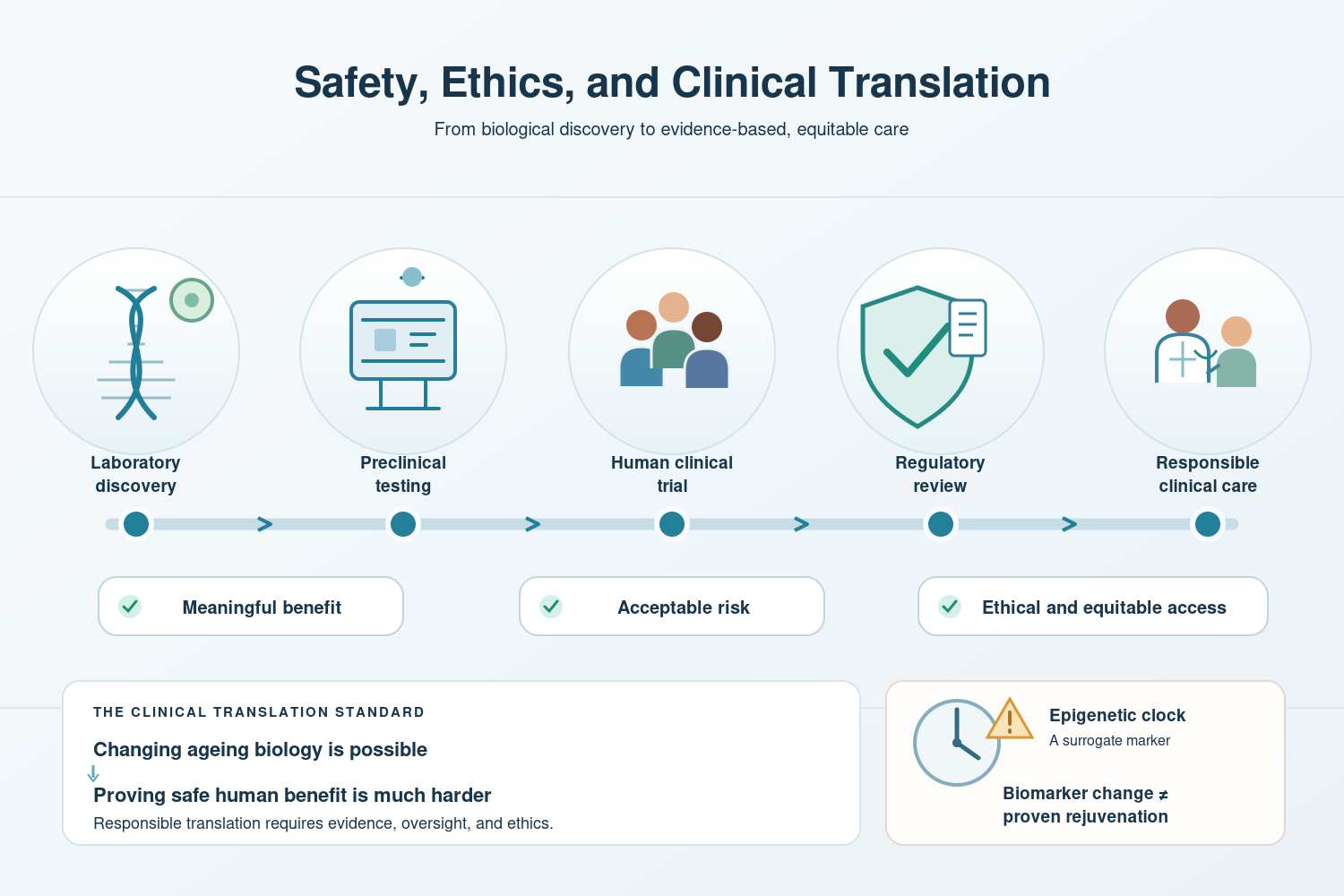
An epigenetic clock can move younger without proving that an organ became younger.
A treatment can work in mice but fail in humans.
A powerful intervention can also produce a biological effect while creating unacceptable risks.
Clinical translation therefore requires a chain of evidence:
mechanism → reproducible preclinical effect → human safety → meaningful human benefit → long-term monitoring → responsible clinical use
Researchers working on geroscience have emphasized that ageing biomarkers need validation against outcomes people actually care about—disease, physical and cognitive function, disability, and survival—before biomarker changes can substitute for those outcomes. (Review, Research)
For direct genome or epigenome engineering, another layer is added: specificity, delivery, permanence, unintended effects, governance, and the possibility that changes could be difficult to reverse. FDA and WHO frameworks therefore place strong emphasis on safety assessment and oversight. (FDA, Guideline)
This final article is about that boundary between interesting science and responsible medicine.
Informational only; no medical, dosing, or emergency instructions.
Quick Summary
- Ageing biology is experimentally modifiable, but biological modification is not the same as demonstrated rejuvenation. (Review)
- A younger epigenetic clock is a biomarker result and is not automatically proof of reduced disease, better function, or longer life. (Review)
- Geroscience researchers increasingly favor trials that measure multiple age-related diseases, function, and outcomes meaningful to participants. (Research)
- Partial cellular reprogramming requires especially careful control because pushing cells too far may alter their identity or create abnormal growth risks. (Review)
- Genome-editing products require evaluation of target specificity, unintended genomic changes, durability, manufacturing quality, and clinical safety. (FDA)
- WHO governance recommendations emphasize oversight, transparency, registries, international cooperation, and equity. (Guideline)
- Early human geroscience studies commonly focus on safety, tolerability, function, immunity, or disease-specific outcomes rather than human lifespan. (Research, Research)
- Commercial availability of a longevity supplement does not mean that the product has been shown to slow or reverse ageing. (FDA)
- Unapproved regenerative products can cause serious harm and should not be confused with validated rejuvenation therapies. (FDA)
- No intervention in this series has established broad, safe reversal of human ageing with demonstrated extension of human lifespan.
What It Is (Clinical Definition & Classification)
Clinical translation means taking a scientific discovery and moving it through increasingly demanding stages of testing until it can—if the evidence supports it—be used responsibly in patients.
A useful way to understand the process is as five levels.
Level 1 — Does the intervention change the intended biology?
This is the first question.
Researchers may ask whether an intervention changes:
- mTOR signalling
- NAD metabolism
- autophagy
- cellular senescence
- DNA methylation
- histone regulation
- gene expression
- an epigenetic clock
If it does, the intervention is biologically active.
That is useful information.
It is not yet evidence that people will live healthier or longer.
Level 2 — Does the biological change improve cells, tissues, or animal health?
The next step is preclinical research.
“Preclinical” means research performed before routine testing as a treatment in people.
Scientists may study:
- cultured human cells
- organ-like laboratory models
- mice
- other animals
They may measure tissue repair, disease markers, function, lifespan, or toxicity.
This stage helps identify whether an intervention deserves human testing.
It cannot establish human efficacy.
Level 3 — Can humans receive it with acceptable risk?
Early human studies commonly focus on:
- adverse events
- tolerability
- whether the intended tissue is reached
- whether the biological target changes
- whether treatment can be delivered consistently
This is a particularly important stage for ageing interventions because they may eventually be considered for people who are not acutely ill.
The acceptable risk for a healthy person is generally different from the acceptable risk for someone with a severe, otherwise untreatable disease.
Level 4 — Does it produce meaningful health benefits?
This is where many longevity claims become difficult.
A meaningful outcome might include:
- fewer age-related diseases
- slower physical decline
- preserved cognition
- lower frailty
- fewer hospitalizations
- longer time living independently
- longer disease-free survival
Experts developing geroscience trial frameworks increasingly emphasize multiple dimensions of health and function rather than one blood biomarker. (Research)
Level 5 — Can it be used responsibly in real medicine?
Even a successful trial is not the end.
Researchers and regulators still need to understand:
- long-term safety
- rare adverse events
- which people benefit
- which people are at greater risk
- manufacturing consistency
- affordability
- access
- monitoring
- informed consent
This is what turns an experimental technology into a mature therapy.
Why It Happens (Causes & Risk Factors)
Clinical translation is unusually difficult in ageing research because ageing is not one isolated biological defect.
It affects many systems at the same time.
These include:
- immune function
- metabolism
- cardiovascular biology
- brain function
- muscle
- DNA repair
- cellular senescence
- mitochondrial function
- epigenetic regulation
That creates several problems.
One intervention may have several effects
A treatment may improve one pathway while worsening another.
This is especially relevant to drugs that change powerful growth, immune, or epigenetic systems.
Older adults are biologically diverse
Two 75-year-olds can have very different:
- organ function
- medication exposure
- frailty
- disease burden
- immune function
- physical reserve
A reserve is the body’s ability to tolerate stress and recover.
That means an intervention can have very different risk-benefit profiles in different people.
Treatments may be intended for healthy people
Many proposed geroprotective treatments are not aimed only at a diagnosed disease.
They may eventually be considered for people who feel well.
That raises the evidence standard because exposing healthy people to long-term risk requires a convincing expected benefit.
Mechanisms / Pathophysiology
Biomarker change is not the same as health improvement
A biomarker is something measurable that provides information about biology.
Examples include:
- cholesterol
- inflammatory proteins
- DNA methylation
- NAD levels
- epigenetic clocks
- senescence markers
A biomarker can be scientifically useful even if it does not directly tell us whether a person will remain healthy.
A surrogate endpoint is different.
It is a biomarker that has been validated well enough to stand in for a meaningful clinical outcome.
For an ageing biomarker to serve that role, researchers would need to show that when treatment moves the biomarker, the expected improvement in health also occurs reliably. (Review)
That has not been established universally for epigenetic clocks.
Why this matters
Imagine an intervention makes a DNA-methylation clock look two years younger.
There are two possible interpretations:
Careful interpretation:
The treatment changed that biomarker.
Much stronger interpretation:
The person’s organs became two years younger and future disease risk fell accordingly.
Only the first statement is directly demonstrated by the clock result.
Direct engineering raises a different level of safety concern
Metabolic interventions often produce effects that decrease after exposure stops.
Direct genome or epigenome engineering may create much longer-lasting changes.
That changes the safety problem.
FDA guidance for human genome-editing products therefore addresses:
- target specificity
- editing efficiency
- unintended changes
- biological activity
- durability
- manufacturing
- nonclinical safety
- clinical-trial design
(FDA)
What is an off-target effect?
An off-target effect is a biological change somewhere other than the intended target.
For genome editing, this can include unintended DNA changes.
For epigenetic editing, it can also mean unintended changes in gene regulation.
The 2026 FDA draft guidance specifically discusses next-generation sequencing approaches for identifying off-target editing and threats to genome integrity. (FDA)
Partial reprogramming has another problem: identity
A liver cell must remain a liver cell.
A nerve cell must remain a nerve cell.
Partial reprogramming aims to reset some ageing-associated cellular programs without pushing the cell all the way back toward a stem-cell-like state.
Current reviews identify loss of cell identity, inappropriate growth, delivery, tissue targeting, and timing of exposure as major translational challenges. (Review, Review)
A useful analogy is:
Partial reprogramming tries to renovate an old house without demolishing the structure that makes it that house.
If the intervention goes too far, the biological identity that needs to be preserved may be disturbed.
Symptoms, Patterns, and Differential Clues
There is no clinical symptom that shows someone requires epigenetic rejuvenation.
Fatigue does not establish it.
Wrinkles do not establish it.
Brain fog does not establish it.
A slow walking speed does not identify one epigenetic target.
And a biological-age test does not diagnose a specific mechanism that can be treated.
This matters because commercial longevity medicine can sometimes turn broad symptoms into claims about one specific ageing pathway without sufficient evidence.
Age-related symptoms still require their usual disease-specific clinical interpretation.
Evaluation & Diagnosis (Clinical Context)
For experimental ageing therapies, evaluation means asking a series of increasingly strict questions.
Did the intervention reach the right tissue?
This is called biodistribution.
A liver therapy must reach enough liver cells.
A brain-directed therapy must reach the relevant brain cells.
A systemic treatment may reach many tissues, which can increase both opportunity and risk.
Did it hit the intended biological target?
This is target engagement.
For example, investigators may measure whether:
- mTOR activity changed
- NAD increased
- senescent-cell markers changed
- a selected gene became more or less active
Did anything unintended happen?
Researchers look for:
- off-target changes
- liver or kidney toxicity
- immune reactions
- abnormal cell growth
- infection
- unexpected changes in other tissues
Did a biomarker change?
This can provide evidence that the treatment affected ageing-related biology.
But it is not sufficient by itself.
Did the person’s health change?
This is the crucial step.
Geroscience researchers increasingly emphasize function, disease outcomes, and patient priorities. (Research)
Did the benefit last?
Durability is especially important for genetic and epigenetic interventions.
A long-lasting benefit may be desirable.
A long-lasting adverse effect is harder to reverse.
Treatment Options Snapshot (Evidence-Graded, Descriptive Only)
No therapy is established specifically to produce broad epigenetic rejuvenation of healthy humans.
The interventions below illustrate different stages of translation.
Procedures / Devices / Technologies
- Partial cellular reprogramming — Experimental human-cell and animal research has studied epigenetic age, cell identity, tissue repair, regenerative capacity, and ageing-related molecular pathways. Current reviews identify tumor-related risk, loss of identity, delivery, and control of exposure as major unresolved barriers before broad human translation. Evidence: Emerging. (Review)
- CRISPR genome and epigenome editing — Human genome-editing therapies can be developed for defined diseases, but regulators require detailed assessment of editing specificity, product quality, unintended genomic changes, durability, and clinical safety. Ageing-directed epigenome editing remains experimental and has not demonstrated general human rejuvenation. Evidence: Emerging. (FDA)
- Senolytic treatment — In a randomized pilot involving 12 people over age 50 with idiopathic pulmonary fibrosis, researchers assessed adverse events, feasibility, pulmonary measures, frailty, and physical function after dasatinib-plus-quercetin exposure. The trial was too small to establish efficacy and was designed mainly to inform further safety and feasibility research. Evidence: Emerging. (Research)
- TORC1 inhibition — A phase 2a randomized trial in 264 older adults measured infection rates, influenza-vaccine response, and antiviral gene expression after short-term TORC1 inhibition. Selected immune outcomes changed, but the study did not test human lifespan or establish broad rejuvenation. Evidence: Limited-Mixed. (Research)
- Metformin as a geroscience trial framework — The TAME concept was designed to test whether a treatment targeting ageing biology could delay the occurrence of multiple age-related diseases rather than relying on one molecular marker. The framework is important for trial methodology, but a proposed trial design is not itself evidence that metformin extends human lifespan. Evidence: Emerging. (Review)
Supplements / Vitamins (Research Context Only)
Forty supplement and nutrient candidates were screened.
Available direct human supplement evidence was more limited than the evidence available for standard medical treatment categories in this condition.
The central translation issue is that a supplement can be commercially available even when its effect on ageing outcomes remains uncertain.
Tier A — Strong / Moderate Evidence
- Omega-3 fatty acids — In 777 older participants from the DO-HEALTH randomized trial, researchers measured PhenoAge, GrimAge2, and DunedinPACE over three years. Small favourable changes occurred in selected clocks, corresponding to relatively modest differences rather than dramatic age reversal, and the study did not establish lifespan extension. Evidence: Moderate. (Research)
- Multivitamin-multimineral supplementation — In 958 older adults from a randomized COSMOS ancillary study, researchers measured five epigenetic ageing measures over two years. PCGrimAge and PCPhenoAge progressed slightly more slowly, but the clinical importance of the relatively small differences remains uncertain. Evidence: Moderate. (Research)
Tier B — Limited-Mixed Evidence
- Vitamin D — Vitamin D was tested within the DO-HEALTH factorial trial using several DNA-methylation ageing measurements. Independent effects were less consistent than those observed for omega-3, while a combined vitamin-D, omega-3, and exercise arm produced an additional signal on one clock, preventing a broad claim of vitamin-D-mediated age reversal. Evidence: Limited-Mixed. (Research)
- NMN — Randomized studies in middle-aged and older adults have measured blood NAD-related biomarkers, physical-performance measures, subjective health, metabolic outcomes, and adverse events. Short-term human studies demonstrate biological activity and generally acceptable tolerability in studied populations, but they do not demonstrate reduced age-related disease or longer human lifespan. Evidence: Limited-Mixed. (Research)
- Urolithin A — A randomized clinical trial in older adults measured muscle endurance, six-minute walk distance, mitochondrial ATP production, circulating metabolic markers, and adverse events. Some endurance and biomarker outcomes changed while major between-group walking and ATP-production differences were not significant, demonstrating why selective positive outcomes should not be generalized to rejuvenation. Evidence: Limited-Mixed. (Research)
- GlyNAC — A randomized trial in older adults measured glutathione, oxidative stress, mitochondrial function, inflammation, insulin resistance, gait speed, muscle strength, and six-minute walk distance. Multiple measured outcomes changed in the small studied sample, but the trial does not establish general age reversal or lifespan extension. Evidence: Limited-Mixed. (Research)
Tier C — Emerging Evidence
- Nicotinamide riboside — A randomized pilot in 20 older adults with mild cognitive impairment measured blood NAD+, cognition, cerebral blood flow, physical measures, DNA methylation, and adverse events. Blood NAD+ increased and adverse-event reporting did not differ between groups, but the small study did not demonstrate broad cognitive or clinical rejuvenation. Evidence: Emerging. (Research)
- Fisetin — An uncontrolled pilot in ten adults over age 50 measured a commercial DNA-based biological-age estimate and telomere length. Four participants had a younger estimate, five had an older estimate, and one did not change, demonstrating highly inconsistent evidence rather than a reproducible human age-reversal effect. Evidence: Emerging. (Research)
The regulatory distinction matters.
Dietary supplements are not generally preapproved by FDA for safety and effectiveness before they enter the market in the way new drugs are. Commercial availability therefore should not be interpreted as geroscience validation. (FDA)
Dietary Sources (Research Context Only)
Fourteen dietary approaches were screened.
Direct human dietary-source evidence was narrower than the target item count.
- Calorie restriction — The two-year CALERIE randomized trial measured DunedinPACE, PhenoAge, and GrimAge in 220 adults without obesity. DunedinPACE slowed modestly while PhenoAge and GrimAge did not significantly reverse, showing that one ageing measure can respond while others remain unchanged. Evidence: Moderate. (Research)
- Vegan diet — An eight-week randomized identical-twin study measured PCGrimAge, PCPhenoAge, DunedinPACE, and organ-system methylation measures. Several measures moved favourably in the vegan arm, but calorie intake and weight change differed, limiting attribution to the diet’s composition alone. Evidence: Limited-Mixed. (Research)
- Mediterranean-style diet — A one-year pilot in older adults measured Horvath DNA-methylation age. Favourable changes were concentrated in selected country, sex, and baseline-age subgroups and were not uniform across the entire population. Evidence: Emerging. (Research)
The dietary evidence illustrates the same translation principle seen with drugs and supplements:
An intervention can move a biomarker without proving that organism-wide ageing has been reversed.
What Research Has Studied
- Biomarker validation: whether biological-age measures can eventually serve as trustworthy clinical-trial endpoints. (Review)
- Clinical endpoints: how disease, physical function, cognition, and patient-reported outcomes should be combined in geroscience trials. (Research)
- Trial harmonization: how geroscience studies can use more comparable biological and functional datasets. (Review)
- Senolytic safety: early randomized human research has focused on tolerability and feasibility before making broader ageing claims. (Research)
- mTOR translation: infection and immune-response outcomes have been tested directly in older adults. (Research)
- Partial reprogramming safety: researchers are studying preservation of cell identity, tumor-related risk, delivery, and treatment timing. (Review)
- Genome-editing safety: regulators require investigation of off-target changes, genome integrity, durability, and manufacturing quality. (FDA)
- International governance: WHO guidance addresses registries, unethical or unsafe research, global oversight, and international equity. (Guideline)
- Premature commercialization: FDA has documented harms associated with unapproved regenerative-medicine interventions. (FDA)
- Clinical ethics and equity: emerging longevity medicine raises questions about access, expectations, evidence standards, and clinicians’ responsibilities. (Review)
Safety, Interactions & Regulatory Context
Risk should match expected benefit
Medicine always balances benefit against harm.
But ageing interventions create an unusual situation.
If a treatment is offered to a healthy person with no immediate disease, the expected future benefit must justify exposing that person to risk now.
This makes safety thresholds particularly important.
Reversibility matters
A treatment taken temporarily may produce effects that fade.
A genetic or persistent epigenetic intervention may continue acting long after treatment.
That difference affects:
- informed consent
- trial design
- monitoring
- acceptable uncertainty
Off-target effects matter
FDA’s genome-editing guidance requires evaluation of unintended changes and target specificity. (FDA)
The agency’s 2026 draft guidance adds specific attention to next-generation sequencing methods that can identify off-target events and threats to genome integrity. (FDA)
Long-term monitoring may be necessary
A durable treatment can create delayed effects.
Clinical translation may therefore require observation long after the initial intervention.
This is especially important for:
- gene therapies
- genome editing
- long-lasting epigenetic editing
- stem-cell-related interventions
Unapproved regenerative medicine is not the same as clinical translation
FDA has warned about unapproved products marketed as regenerative medicine and documented risks including:
- infection
- unwanted inflammatory reactions
- unintended tissue formation
- tumor formation
- treatment failure
(FDA)
The fact that an intervention is marketed in a clinic does not demonstrate that it has completed rigorous translation.
Supplements have a different regulatory pathway
Dietary supplements are regulated differently from prescription drugs.
FDA generally does not approve supplements for effectiveness before marketing. (FDA)
This is particularly important in longevity medicine because consumers may encounter products long before there is strong ageing-specific human evidence.
Governance extends beyond safety
WHO’s genome-editing framework considers issues including:
- international research
- registries
- unethical or unsafe practices
- intellectual property
- education
- public engagement
- equity
That reflects a broader principle:
A treatment can be technically possible and still require ethical limits on how, where, and for whom it is used.
Evidence Overview
The 15 articles in this series cover interventions ranging from indirect metabolic modulation to direct epigenetic engineering.
The evidence is not equally mature across those categories.
Metabolic modulation is closest to ordinary medicine
Interventions such as metformin, mTOR inhibitors, omega-3 fatty acids, NAD-related compounds, and dietary changes generally work through existing metabolic pathways.
Some have substantial human safety experience.
That does not mean they are proven anti-ageing treatments.
Human ageing outcomes remain much less established than their ordinary disease-specific or metabolic effects.
Senolytics have entered early human testing
Senolytic research demonstrates a typical translational pathway.
Researchers did not begin by claiming human lifespan extension.
Early trials studied feasibility, adverse events, function, and disease-specific outcomes. (Research)
This is how cautious translation should work.
Epigenetic clocks are useful but not enough
Article 10 examined why a clock becoming younger does not automatically mean the body became younger.
That problem remains central here.
Researchers evaluating geroscience endpoints specifically caution that a biological-age biomarker must show that treatment-induced biomarker change predicts meaningful clinical benefit before it can serve as a true surrogate. (Review)
Direct epigenetic engineering is more powerful—and potentially harder to undo
CRISPR epigenome editing can aim at a particular DNA address.
Partial reprogramming can alter broad cellular states.
That precision or power is scientifically exciting.
It also changes the safety standard.
A supplement that fails may simply do little.
A durable editing intervention that fails in the wrong way could potentially alter cell behavior for a long time.
This is why clinical translation cannot be driven by potency alone.
Regulatory precedent exists for advanced genetic medicine
FDA has approved multiple cellular and gene therapies for specific diseases. (FDA)
That proves something important:
Advanced genetic technologies can become real medicine.
But they have done so for defined diseases with specific indications, evidence requirements, manufacturing controls, and risk-benefit evaluations.
That is very different from approving a treatment to make otherwise healthy adults broadly “younger.”
Ethics becomes more difficult as treatment moves toward enhancement
There is a difference between:
treating Parkinson disease
and:
modifying a healthy person to remain biologically younger.
The second raises additional questions:
- What counts as disease versus normal ageing?
- How much risk is acceptable?
- Who gets access?
- Could long-lived therapies widen socioeconomic inequality?
- Could employers or insurers eventually pressure people to use biological-age testing?
- Who controls genetic or epigenetic data?
- How should enhancement be distinguished from treatment?
WHO’s genome-editing governance work explicitly recognizes that human editing technologies require ethical and social governance in addition to technical safety. (Guideline)
Equity is not an optional final consideration
An intervention that extends healthy life but is accessible only to wealthy populations could increase disparities in:
- disability
- disease burden
- health-care costs
- healthy life expectancy
Ethical clinical translation therefore includes not only whether a technology works, but whether its benefits and burdens are distributed fairly. (Review)
The endpoint problem remains central
The most important methodological question is:
What would count as proof that an ageing intervention works?
An epigenetic clock alone is not enough.
One inflammatory marker is not enough.
One mitochondrial biomarker is not enough.
Expert geroscience work increasingly favors combinations of:
- disease outcomes
- physical function
- cognitive function
- patient-reported outcomes
- validated biological markers
That is probably the direction clinical translation will need to take.
Evidence Confidence Classification
Overall Rating: Emerging
Confidence is Strong that many biological processes associated with ageing can be experimentally modified and that advanced cell and gene therapies can be translated into medicine for specific diseases. Confidence is Moderate that selected geroscience interventions can produce measurable human biological or functional changes. Evidence remains Emerging for safe, durable, broad rejuvenation of humans through direct epigenetic engineering, and no intervention in this series has demonstrated generalized human lifespan extension. (Review, Review)
What Does Not (Evidence Gaps)
- A younger biological-age test as proof of rejuvenation — A treatment-induced biomarker change must be shown to predict meaningful clinical benefit before the biomarker can substitute for disease, function, or survival outcomes. (Review)
- Animal lifespan extension as human longevity evidence — Animal research is critical for discovery, but species differences in metabolism, immune systems, delivery, toxicity, and lifespan prevent automatic translation to people.
- Commercial availability as proof of efficacy — Dietary supplements can be sold under a regulatory framework different from drug approval, so availability does not establish a human anti-ageing effect. (FDA)
- A regenerative-medicine clinic as proof of validated rejuvenation — FDA has warned that unapproved regenerative products may be marketed without adequate evidence and have caused serious adverse outcomes. (FDA)
- No DNA cutting as proof of safety — Epigenome-editing systems can still create unintended regulatory effects, while genome-editing programs require explicit assessment of off-target changes and genome integrity. (FDA)
- Technical ability as automatic ethical permission — WHO governance recommendations emphasize safety, transparency, oversight, public engagement, international cooperation, and equity even when an editing technology is technically possible. (Guideline)
FAQ
1. What does “clinical translation” mean?
Clinical translation is the process of moving a scientific discovery toward safe and evidence-based use in people.
It includes laboratory work, preclinical research, human trials, regulatory review, and long-term monitoring.
2. Why isn’t changing an ageing biomarker enough?
Because a biomarker can move without changing health.
Researchers need evidence that treatment-induced biomarker changes reliably correspond to outcomes such as fewer diseases, better function, or longer healthy survival. (Review)
3. What is a clinical endpoint?
A clinical endpoint is a health outcome that matters directly to people.
Examples include disease occurrence, physical disability, hospitalization, cognitive decline, or mortality.
4. What is a surrogate endpoint?
A surrogate endpoint is a biomarker validated strongly enough to substitute for a clinical outcome.
Epigenetic clocks have not yet been universally validated for this purpose in geroscience. (Review)
5. What outcomes should an ageing trial measure?
Current expert work favors several dimensions, including age-related disease, physical or cognitive function, and patient-reported outcomes.
The appropriate measures also depend on the population being studied. (Research)
6. Why can’t human lifespan simply be the main endpoint?
Human lifespan takes decades to measure.
It would make many trials extremely long, expensive, and difficult.
Researchers therefore need shorter outcomes that still have demonstrated relevance to health and survival.
7. What is healthspan?
Healthspan means the period of life spent in relatively good health and function.
A treatment could theoretically extend healthspan without greatly changing maximum lifespan.
8. Why is partial reprogramming considered risky?
Partial reprogramming deliberately changes cell state.
If control is inadequate, cells could lose their normal identity or enter abnormal states associated with uncontrolled growth. (Review)
9. What makes CRISPR epigenome editing different from a supplement?
A supplement generally affects broad metabolic pathways.
CRISPR epigenome editing can be designed to regulate a chosen DNA location.
That increased precision also creates additional concerns about delivery, specificity, and durable unintended effects.
10. What is an off-target effect?
It is a biological effect at an unintended location.
FDA guidance for genome-editing products specifically addresses assessment of off-target events and unintended genome changes. (FDA)
11. What is germline editing?
Germline or heritable editing means altering reproductive cells or embryos in a way that may transmit the change to future generations.
This carries ethical and governance concerns beyond ordinary treatment of a patient’s nonreproductive cells. (Guideline)
12. Why is informed consent especially important for longevity interventions?
Some effects may be long-lasting and some uncertainties may not be resolved for years.
Participants therefore need to understand both the hoped-for benefit and the possibility of unknown or delayed risk.
13. Why is equity part of the science?
A therapy’s real-world health effect depends partly on who can access it.
A costly intervention that is available only to a small population could increase existing differences in healthy life expectancy. (Review)
14. Are any advanced gene therapies already approved?
Yes.
FDA has approved multiple cellular and gene therapies for specific diseases, showing that advanced genetic technologies can reach clinical medicine when their evidence and manufacturing meet regulatory standards. (FDA)
15. Is there an approved gene therapy for general human rejuvenation?
No.
Current FDA-approved cellular and gene therapies have defined disease indications rather than a general indication to reverse ageing. (FDA)
16. Are longevity supplements tested the same way as prescription drugs?
No.
Dietary supplements generally do not undergo FDA premarket approval for effectiveness in the way prescription drugs do. (FDA)
17. Do omega-3 or multivitamins prove that ageing is reversible?
No.
Randomized trials have reported small changes in selected DNA-methylation ageing measures, but those findings do not demonstrate broad human rejuvenation or longer lifespan. (Research, Research)
18. Why are early pilot studies useful if they cannot prove efficacy?
They can identify:
- adverse events
- feasibility problems
- delivery challenges
- biological activity
- useful outcome measures
That information helps determine whether a larger trial is justified.
19. What would convincing evidence of human rejuvenation look like?
At minimum, it would require reproducible controlled human studies showing that an intervention produces meaningful improvements in ageing-related health with acceptable risk.
Ideally, those benefits would extend across function, disease burden, and long-term health rather than one isolated molecular marker.
20. What is the final conclusion of this 15-article series?
Modern biology increasingly shows that ageing is modifiable at the level of cells, pathways, and biomarkers.
That is scientifically important.
But there is still a large gap between modifying ageing biology and safely rejuvenating human beings.
The next major advance will not be established merely by finding another compound that changes a molecular pathway.
It will require demonstrating:
meaningful human benefit, acceptable long-term risk, reliable biomarkers, rigorous clinical trials, ethical governance, and fair access.
That is the point at which epigenetic engineering of ageing would move from an experimental field toward mature medicine.
Resources
Endpoints for Geroscience Clinical Trials: Health Outcomes, Biomarkers, and Biologic Age — Review — https://pubmed.ncbi.nlm.nih.gov/36260264/
Selecting Appropriate Clinical Trial Endpoints for Geroscience Trials — Research — https://pubmed.ncbi.nlm.nih.gov/39989956/
Insights on Geroscience Preclinical and Clinical Trials to Promote Healthy Aging — Review — https://pubmed.ncbi.nlm.nih.gov/41863810/
Should Clinicians Be Agents of Anti-Aging? — Review — https://pubmed.ncbi.nlm.nih.gov/41411401/
Human Genome Editing: Recommendations — Guideline — https://www.who.int/publications/i/item/9789240030381
Human Genome Editing: A Framework for Governance — Guideline — https://www.who.int/publications-detail-redirect/9789240030060
ISSCR Guidelines for Stem Cell Research and Clinical Translation — Guideline — https://pubmed.ncbi.nlm.nih.gov/34048692/
Human Gene Therapy Products Incorporating Human Genome Editing — FDA — https://www.fda.gov/regulatory-information/search-fda-guidance-documents/human-gene-therapy-products-incorporating-human-genome-editing
Safety Assessment of Genome Editing Using Next-Generation Sequencing — FDA — https://www.fda.gov/regulatory-information/search-fda-guidance-documents/safety-assessment-genome-editing-human-gene-therapy-products-using-next-generation-sequencing
Important Patient and Consumer Information About Regenerative Medicine Therapies — FDA — https://www.fda.gov/vaccines-blood-biologics/consumers-biologics/important-patient-and-consumer-information-about-regenerative-medicine-therapies
Approved Cellular and Gene Therapy Products — FDA — https://www.fda.gov/vaccines-blood-biologics/cellular-gene-therapy-products/approved-cellular-and-gene-therapy-products
Questions and Answers on Dietary Supplements — FDA — https://www.fda.gov/food/information-consumers-using-dietary-supplements/questions-and-answers-dietary-supplements
Conserved Biological Processes in Partial Cellular Reprogramming — Review — https://pubmed.ncbi.nlm.nih.gov/40122394/
The Epigenetic Rejuvenation Promise: Partial Reprogramming as a Therapeutic Strategy — Review — https://pubmed.ncbi.nlm.nih.gov/41490578/
Cellular Reprogramming Beyond Pluripotency — Review — https://pubmed.ncbi.nlm.nih.gov/41864756/
Senolytics in Idiopathic Pulmonary Fibrosis: Randomized Pilot Trial — Research — https://pubmed.ncbi.nlm.nih.gov/36857968/
TORC1 Inhibition Enhances Immune Function and Reduces Infections in Older Adults — Research — https://pubmed.ncbi.nlm.nih.gov/29997249/
Metformin as a Tool to Target Aging — Review — https://pubmed.ncbi.nlm.nih.gov/27304507/
DO-HEALTH Vitamin D, Omega-3, Exercise, and DNA-Methylation Age — Research — https://pubmed.ncbi.nlm.nih.gov/39900648/
COSMOS Multivitamin and Epigenetic-Age Trial — Research — https://pubmed.ncbi.nlm.nih.gov/41803341/
Nicotinamide Riboside in Older Adults With Mild Cognitive Impairment — Research — https://pubmed.ncbi.nlm.nih.gov/37994989/
NMN in Healthy Middle-Aged Adults — Research — https://pubmed.ncbi.nlm.nih.gov/36482258/
Urolithin A and Muscle Endurance in Older Adults — Research — https://pubmed.ncbi.nlm.nih.gov/35050355/
GlyNAC in Older Adults — Research — https://pubmed.ncbi.nlm.nih.gov/35975308/
Fisetin Biological-Age Pilot — Research — https://pubmed.ncbi.nlm.nih.gov/39269340/
CALERIE Calorie Restriction and DNA-Methylation Age — Research — https://pubmed.ncbi.nlm.nih.gov/37118425/
Vegan Diet and Epigenetic Age in Identical Twins — Research — https://pubmed.ncbi.nlm.nih.gov/39069614/
Mediterranean Diet and Epigenetic Age in Older Adults — Research — https://pubmed.ncbi.nlm.nih.gov/31981007/