
Introduction
DNA methylation requires raw material.
When a cell places a methyl tag on DNA or on the proteins around DNA, that methyl group has to come from somewhere.
The body obtains and moves those small chemical units through a metabolic network called one-carbon metabolism. (Review)
The name sounds complicated, but the basic idea is not.
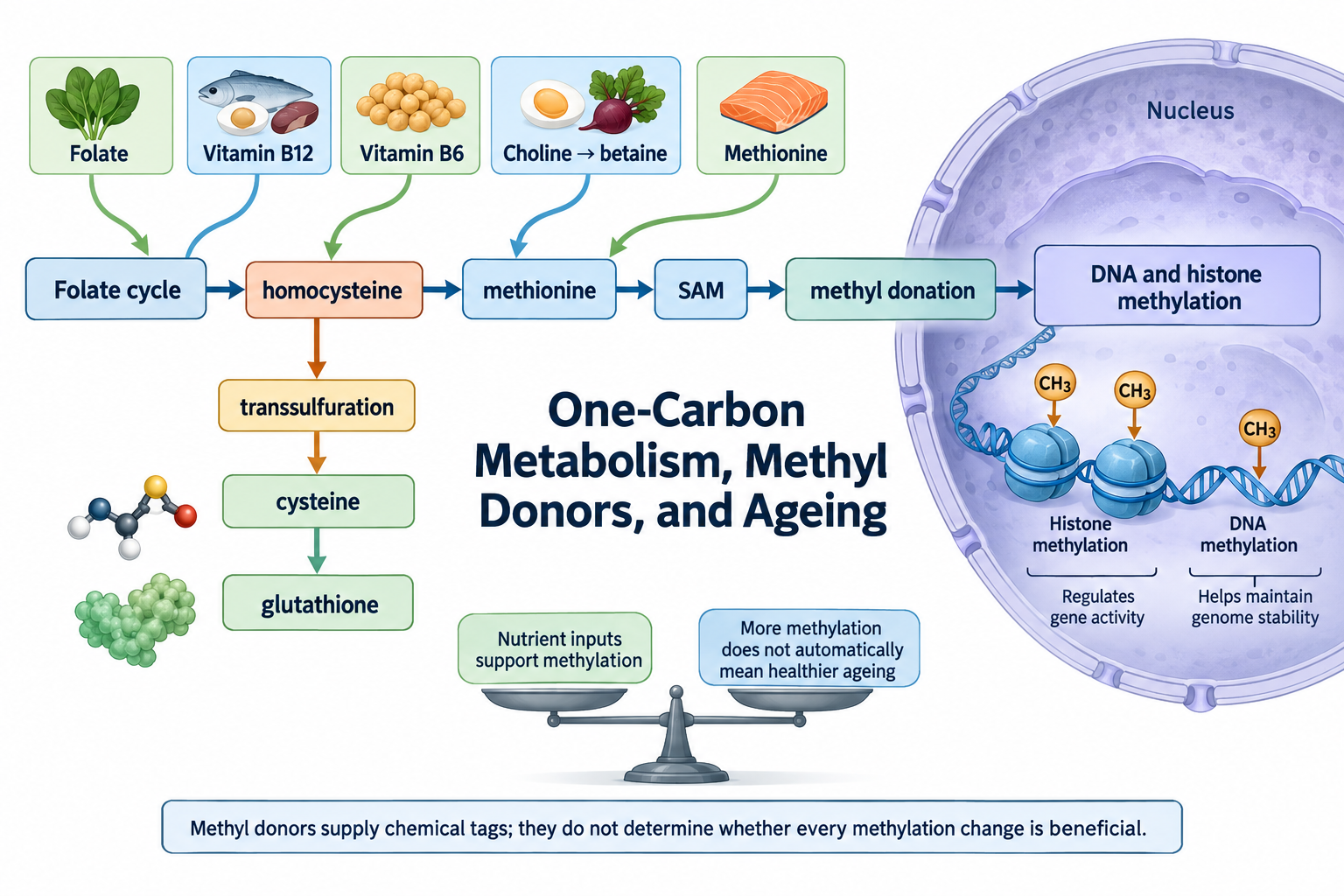
One-carbon metabolism is the body’s methyl-supply network.
It uses nutrients such as:
- folate
- vitamin B12
- vitamin B6
- choline
- betaine
- methionine
These nutrients help the body build DNA, process amino acids, recycle homocysteine, make antioxidant defenses, and produce a molecule called S-adenosylmethionine, or SAM. (Review)
SAM is especially important because it carries methyl groups to many biological reactions.
A useful analogy is:
If DNA methylation places regulatory sticky notes on DNA, SAM is one of the delivery trucks carrying those sticky notes.
This explains why methyl donors receive so much attention in epigenetic ageing research.
But it also creates one of the biggest misunderstandings in the field:
Giving the body more methyl donors does not automatically make DNA methylation healthier or younger.
Ageing does not simply mean “too little methylation.”
Some DNA locations gain methylation with age.
Others lose it.
Some methylation changes are harmless, some may reflect altered regulation, and some are simply biomarkers.
Human studies show that folate, B12, betaine, choline, and methionine availability can alter one-carbon metabolism and sometimes DNA methylation. The evidence that manipulating these nutrients reverses human biological ageing, however, remains limited and inconsistent. (Review, Research)
Informational only; no medical, dosing, or emergency instructions.
Quick Summary
- One-carbon metabolism moves small carbon units needed for DNA synthesis, amino-acid metabolism, and methylation reactions. (Review)
- Folate, vitamin B12, vitamin B6, choline, betaine, and methionine all participate in different parts of this network. (Review)
- The pathway produces SAM, a major molecule that supplies methyl groups for DNA, histone, RNA, and protein methylation. (Review)
- Homocysteine is an intermediate in the methionine cycle; folate and B12 help recycle it toward methionine. (Authority)
- More methyl donors do not automatically mean healthier or younger DNA methylation.
- Folic acid plus vitamin B12 changed epigenetic-age measurements in selected genetic and sex subgroups rather than producing a universal age-reversal effect. (Research)
- B-vitamin combinations can lower homocysteine and have produced benefits in selected older populations, but results vary across trials. (Research, Research)
- Betaine reliably lowers homocysteine in many human studies, but this has not been shown to reverse biological ageing. (Review)
- An eight-week human methionine-restriction intervention did not significantly change epigenetic ageing clocks. (Research)
- One-carbon metabolism is essential for normal biology, but “optimizing methylation” is not a validated anti-ageing treatment concept.
What It Is (Clinical Definition & Classification)
One-carbon metabolism is a group of connected chemical reactions that move tiny carbon-containing units between molecules.
The system has several jobs.
It helps:
- build DNA
- produce amino acids
- recycle homocysteine
- make methyl donors
- support glutathione production
- regulate epigenetic methylation
The easiest way to understand it is as two connected loops.
The folate cycle
Folate, sometimes called vitamin B9, acts like a carrier.
It transports small one-carbon units used in DNA synthesis and other metabolic reactions.
The methionine cycle
The methionine cycle takes the amino acid methionine and converts it into SAM.
SAM then donates methyl groups.
After SAM gives away a methyl group, the pathway eventually produces homocysteine.
Homocysteine can then be recycled back toward methionine or sent into another metabolic pathway.
The transsulfuration pathway
Some homocysteine can instead enter the transsulfuration pathway.
That pathway contributes to production of cysteine and ultimately glutathione.
Glutathione is one of the body’s major molecules for controlling oxidative stress.
So one-carbon metabolism connects three major areas:
DNA building → methylation → antioxidant defense
(Review)
Why It Happens (Causes & Risk Factors)
One-carbon metabolism is affected by many factors.
These include:
- nutrient intake
- vitamin absorption
- kidney function
- liver function
- alcohol exposure
- genetics
- medications
- inflammation
- ageing itself
Folate status
Folate is required to move one-carbon units through the folate cycle.
Low folate can impair the conversion of homocysteine toward methionine and can raise circulating homocysteine. (Authority)
Vitamin B12 status
Vitamin B12 is needed for a key reaction linking folate metabolism with methionine recycling.
B12 deficiency can therefore disrupt both blood-cell production and neurological function. (Authority)
Genetics
The best-known gene in this area is MTHFR.
MTHFR makes an enzyme involved in producing a form of folate needed for methionine recycling.
A common genetic variant can reduce the enzyme’s activity. (Authority)
But this needs to be kept in perspective:
MTHFR is one enzyme in a large metabolic network.
A genetic variant does not mean that someone’s entire methylation system is defective.
Ageing
Ageing can alter nutrient absorption, kidney function, mitochondrial metabolism, inflammatory signalling, and enzyme activity.
That means one-carbon metabolism may change with age even when diet remains similar. (Review)
Mechanisms / Pathophysiology
Step 1 — Folate carries one-carbon units
Folate is converted into several related chemical forms.
These forms carry small carbon units between reactions.
Those carbon units are used in DNA synthesis and methylation metabolism. (Authority)
Step 2 — Vitamin B12 connects folate to methionine
One B12-dependent reaction helps convert homocysteine back toward methionine.
This is why folate and B12 metabolism are so closely connected.
Step 3 — Methionine becomes SAM
Methionine is converted into S-adenosylmethionine, or SAM.
SAM is sometimes called the universal methyl donor.
“Universal” does not mean it is the only methyl donor.
It means SAM is used by a very large number of methylation reactions.
Step 4 — SAM delivers a methyl tag
Enzymes called methyltransferases take a methyl group from SAM and place it onto another molecule.
Targets include:
- DNA
- histones
- RNA
- proteins
- small metabolites
A DNA methyltransferase places methyl tags on DNA.
A histone methyltransferase places them on histone proteins.
Step 5 — SAM becomes SAH
After SAM donates its methyl group, it becomes S-adenosylhomocysteine, usually shortened to SAH.
SAH matters because it can inhibit methyltransferase enzymes.
This means methylation potential depends partly on the balance between SAM and SAH.
So simply measuring or increasing one nutrient does not describe the entire system. (Review)
Step 6 — Homocysteine reaches a crossroads
Homocysteine can move in two directions.
It can be recycled back toward methionine.
Or it can enter the transsulfuration pathway and contribute to glutathione synthesis.
This makes homocysteine a metabolic crossroads rather than simply a “toxin.”
Where does betaine fit?
Betaine can donate a methyl group that helps convert homocysteine back toward methionine through a pathway that is partly separate from the folate/B12 route.
That is why betaine supplementation tends to lower homocysteine in human studies. (Review)
Where does choline fit?
Choline has several functions.
It is used in cell membranes and in the neurotransmitter acetylcholine.
Some choline is also converted into betaine.
That gives choline an indirect role in methyl-group metabolism. (Review)
Why “more methylation” is not the goal
Suppose a gene needs to be active.
Adding methylation to one of its regulatory regions could reduce its activity.
Elsewhere, different methylation patterns may have different effects.
Ageing itself involves both gains and losses of DNA methylation.
So:
Epigenetic health is about appropriate patterns—not maximizing methylation.
This distinction is fundamental.
Symptoms, Patterns, and Differential Clues
There is no recognized syndrome called “poor methylation.”
Folate or vitamin B12 deficiencies can produce established medical problems.
But symptoms such as:
- fatigue
- memory difficulty
- low mood
- weakness
- poor sleep
- “brain fog”
are nonspecific.
They cannot establish that a person has a methylation problem.
What about homocysteine?
Homocysteine is often used as a marker of one-carbon metabolism.
But it is not specific.
Homocysteine can rise with:
- folate deficiency
- B12 deficiency
- B6-related problems
- kidney dysfunction
- genetics
- other metabolic factors
A high value therefore does not automatically identify one cause. (Authority)
Evaluation & Diagnosis (Clinical Context)
Different measurements provide different information.
Folate
Blood folate can help assess folate status.
Vitamin B12
B12 can be assessed directly, sometimes together with more functional markers when deficiency is suspected.
Homocysteine
Homocysteine reflects several pathways simultaneously.
Lowering it demonstrates that metabolism changed.
It does not prove that ageing changed.
Methylmalonic acid
Methylmalonic acid, or MMA, can rise when cellular B12 availability is inadequate.
It provides different information from homocysteine.
SAM and SAH
These metabolites are useful mainly in research.
Their ratio can provide information about methylation potential.
DNA methylation
Researchers can examine:
- individual DNA sites
- genome-wide methylation
- epigenetic ageing clocks
These measurements should not be treated as interchangeable with nutrient status.
Treatment Options Snapshot (Evidence-Graded, Descriptive Only)
There is no established treatment whose clinical purpose is to rejuvenate the human epigenome by increasing methyl-donor intake.
Supplements / Vitamins (Research Context Only)
Forty nutrient and supplement candidates were screened before evidence classification.
Available direct human supplement evidence was more limited than the evidence available for standard medical treatment categories in this condition.
Tier A — Strong / Moderate Evidence
- Folate plus vitamin B12 for one-carbon metabolism — Folate and B12 are essential components of normal methionine recycling and DNA metabolism. Human evidence consistently shows lower homocysteine when deficiency or pathway responsiveness is present, but this should be interpreted as metabolic correction rather than anti-ageing rejuvenation. Evidence: Moderate. (Authority, Authority)
- B-vitamin combinations in mild cognitive impairment — The randomized VITACOG trial studied older adults with mild cognitive impairment and measured homocysteine, brain-volume loss, cognition, and clinical decline. B-vitamin treatment lowered homocysteine and slowed brain atrophy in the studied population, with effects concentrated particularly among participants with higher baseline homocysteine; this does not establish a general anti-ageing effect. Evidence: Moderate. (Research, Research)
Tier B — Limited-Mixed Evidence
- Folic acid plus vitamin B12 and epigenetic age — Human intervention data showed DNA-methylation-age responses that differed by sex and MTHFR genotype. The finding confirms that methyl-donor nutrition can influence epigenetic measurements, but it does not support a universal age-reversal effect. Evidence: Limited-Mixed. (Research)
- Betaine — Human trials and meta-analysis show reduced circulating homocysteine after betaine supplementation, consistent with betaine’s methyl-donor role. A 2024 crossover trial again showed increased circulating betaine and lower homocysteine, but human epigenetic-age reversal or lifespan extension has not been demonstrated. Evidence: Limited-Mixed. (Review, Research)
- B-vitamin homocysteine lowering after stroke — A large randomized secondary-prevention trial tested B vitamins after ischemic stroke. Homocysteine changed without a correspondingly clear broad improvement in recurrent vascular outcomes, providing an important example of why metabolic-marker improvement should not be equated with clinical rejuvenation. Evidence: Limited-Mixed. (Research)
Tier C — Emerging Evidence
- Choline — Choline can be converted into betaine and thereby support methyl-group transfer. Human studies demonstrate DNA-methylation responsiveness to choline exposure in specific physiological contexts, but direct evidence in older adults showing slower epigenetic ageing is insufficient. Evidence: Emerging. (Research, Review)
- Betaine for ageing outcomes beyond homocysteine — Reviews identify potential effects involving methylation potential, mitochondria, inflammation, and muscle biology, but human evidence specifically in older populations remains too limited for stronger ageing claims. Evidence: Emerging. (Review)
Frequently discussed longevity compounds that were screened but not admitted as direct methyl-donor interventions included NMN, nicotinamide riboside, AKG, spermidine, resveratrol, fisetin, quercetin, taurine, GlyNAC, urolithin A, curcumin, berberine, CoQ10, alpha-lipoic acid, sulforaphane, and omega-3 fatty acids.
They may affect ageing through other pathways.
That does not make them one-carbon interventions.
Dietary Sources (Research Context Only)
Direct human dietary-source evidence was narrower than the target item count.
- Methionine restriction — A 2025 study included an eight-week human intervention specifically reducing methionine exposure. Epigenetic ageing clocks did not significantly change, even though late-life methionine restriction improved multiple physiological outcomes in accompanying mouse studies. This is important evidence that metabolic effects and clock effects can diverge. Evidence: Limited-Mixed. (Research)
- Vegan diet compared with a meat-rich diet — A 2026 randomized isocaloric study measured genome-wide DNA methylation plus several biological-age clocks after one month. Some health-related clocks moved in a favourable direction while another clock showed an opposing response, illustrating how dietary methylation effects depend on the measurement used. Evidence: Limited-Mixed. (Research)
- Folate-rich foods — Leafy green vegetables, legumes, asparagus, Brussels sprouts, avocado, and several fortified grains provide folate. Dietary folate supports normal one-carbon transfer, DNA synthesis, and methionine recycling, but higher-than-adequate intake has not been shown to reset the ageing epigenome. Evidence: Moderate for nutritional adequacy; Limited for age modification. (Authority)
- Vitamin-B12 food sources — Fish, shellfish, meat, eggs, dairy foods, and fortified foods can provide B12. Adequate B12 supports neurological function and normal one-carbon metabolism, but additional intake in already-replete people is not established as a rejuvenation strategy. Evidence: Moderate for nutritional adequacy; Limited for age modification. (Authority)
- Choline-rich foods — Eggs, meat, fish, soy foods, beans, and several vegetables supply choline. Choline can feed methyl metabolism after conversion to betaine, but human evidence does not show that eating additional choline reverses biological ageing. Evidence: Emerging. (Review)
- Plant-rich dietary patterns — Plant-rich diets can simultaneously alter folate, methionine, choline, fibre, polyphenols, body weight, inflammation, and other variables. DNA-methylation changes have been documented, but attribution specifically to methyl donors is difficult. Evidence: Limited-Mixed. (Research)
What Research Has Studied
- Folate and methionine cycles: how one-carbon units move through DNA synthesis and methylation pathways. (Review)
- SAM and SAH: how methyl-donor supply and inhibitory by-products regulate methylation potential. (Review)
- Homocysteine: how folate, B12, B6, and betaine change its concentration. (Review)
- Brain ageing: whether B-vitamin-mediated homocysteine lowering affects brain atrophy and cognition in older adults. (Research)
- Epigenetic age: whether folate plus B12 can alter DNA-methylation-age estimates. (Research)
- Methionine restriction: whether lowering dietary methionine affects ageing-related biology and epigenetic clocks. (Research)
- Betaine: whether an alternative methyl donor changes homocysteine and ageing-related pathways. (Review)
- Choline: how choline availability affects methyl metabolism and DNA methylation. (Review)
- Dietary pattern effects: whether plant-based versus meat-rich diets alter methylation throughout the genome. (Research)
- Biomarker versus clinical outcome: whether lowering homocysteine necessarily produces expected disease benefits. Results show the relationship is not automatic. (Research)
Safety, Interactions & Regulatory Context
Methyl donors are essential nutrients or normal metabolites.
That does not mean that continually increasing methyl-donor exposure is beneficial.
Folate and vitamin B12 must be considered together
High folic-acid exposure can correct the anemia caused by vitamin B12 deficiency while allowing neurological injury from B12 deficiency to continue unnoticed.
That is one reason excessive folic-acid exposure is not biologically equivalent to “better methylation.” (Authority)
Vitamin B12 deficiency becomes more relevant with age
B12 absorption can decline because of gastrointestinal changes, gastric surgery, autoimmune disease, or medication exposure.
B12 therefore illustrates an important distinction:
Correcting inadequate nutrient status is different from using excess nutrient intake as an anti-ageing intervention.
Homocysteine should not be treated as a biological-age score
Homocysteine responds to one-carbon metabolism, but it is also influenced by kidney function and other factors.
A lower value after treatment confirms biochemical activity.
It does not automatically show that tissues became younger.
Methionine restriction is biologically broad
Methionine is an essential amino acid.
Reducing it changes not just SAM production but also protein metabolism, growth signalling, redox pathways, and many other systems.
Human methionine restriction should therefore not be reduced conceptually to “lower methylation.” (Research)
Evidence Overview
One-carbon metabolism has one of the clearest biochemical links to epigenetics in this entire series.
The pathway literally supplies methyl groups used in methylation reactions. (Review)
That part is well established.
The ageing question is more difficult.
Folate and B12 clearly affect the pathway
Folate and B12 help recycle homocysteine and sustain methionine metabolism.
Deficiency can therefore alter one-carbon chemistry substantially. (Authority, Authority)
Lowering homocysteine does not equal rejuvenation
This distinction is critical.
In VITACOG, B-vitamin-mediated homocysteine lowering was associated with slower brain atrophy in a selected population of older adults with mild cognitive impairment. (Research)
In other large randomized settings, such as VISP after stroke, changing homocysteine did not translate into the magnitude of clinical benefit that might have been predicted from observational associations. (Research)
So:
Homocysteine is a useful metabolic marker, but it is not a validated meter of biological rejuvenation.
DNA methylation can respond to methyl-donor nutrition
A human folic-acid-plus-B12 study found changes in epigenetic ageing measurements.
However, the effect depended on sex and MTHFR genotype. (Research)
This is exactly what would be expected from a complex metabolic network.
The same nutrient input does not necessarily produce the same epigenetic response in every person.
Betaine illustrates pathway activity without age reversal
Betaine supplementation lowers homocysteine in human studies. (Review)
That demonstrates biological activity.
It does not demonstrate reversal of ageing.
A 2024 randomized crossover study again showed increased betaine concentrations and lower homocysteine but did not establish a rejuvenation endpoint. (Research)
Methionine restriction illustrates the animal-human gap
Methionine restriction has some of the most striking longevity biology in laboratory animals.
A 2025 study found substantial late-life healthspan benefits in mice.
Yet an eight-week human intervention included in the same research programme did not significantly alter epigenetic ageing clocks. (Research)
That does not prove methionine restriction has no human effects.
It does show that:
An intervention can alter metabolism without automatically making an epigenetic clock younger.
Diet can alter methylation without revealing one simple cause
A 2026 randomized study compared an isocaloric vegan diet with a meat-rich diet.
Genome-wide DNA methylation changed.
Some health-related ageing clocks moved favourably in the vegan group.
Another clock moved in the opposite direction. (Research)
The diets differed in many things at once.
That makes it impossible to say the result came from folate, methionine, choline, fibre, polyphenols, or another single component.
The central conclusion
One-carbon metabolism is unquestionably important for epigenetic regulation.
But the human evidence supports balance and adequacy, not a simple “more methyl donors = younger epigenome” model.
Evidence Confidence Classification
Overall Rating: Limited-Mixed
Confidence is Strong that one-carbon metabolism supplies methyl groups required for epigenetic methylation and that folate, B12, choline, betaine, and methionine influence the pathway. Confidence is Moderate that nutritional manipulation can alter human homocysteine and selected DNA-methylation measurements. Evidence remains Limited-Mixed that manipulating methyl-donor supply slows or reverses human ageing. (Review, Research, Research)
What Does Not (Evidence Gaps)
- More methyl donors as a universal anti-ageing strategy — DNA methylation is site-specific, and ageing involves both gains and losses of methylation. Increasing methyl-group supply has not been shown to restore the ageing epigenome globally. (Review)
- Lower homocysteine as proof of rejuvenation — B vitamins and betaine can lower homocysteine, but randomized clinical outcomes have varied. A biochemical response should not be equated with reversal of ageing. (Research, Review)
- Folic acid plus B12 as universal epigenetic-age reversal — Human clock effects were dependent on sex and MTHFR genotype rather than consistently favourable across all participants. (Research)
- Betaine as a proven longevity supplement — Betaine changes homocysteine metabolism, but human lifespan extension and reproducible epigenetic rejuvenation have not been demonstrated. (Review)
- Methionine restriction as established human age reversal — Animal findings are interesting, but an eight-week human intervention did not significantly alter epigenetic clocks. (Research)
- MTHFR variants as a complete explanation for methylation health — MTHFR is one component of a large nutrient- and enzyme-dependent metabolic system. A common variant does not by itself define biological age or overall methylation capacity. (Authority)
FAQ
1. What is one-carbon metabolism?
One-carbon metabolism is a network of chemical reactions that transfers small carbon units between molecules.
It supports DNA synthesis, amino-acid metabolism, methylation, and antioxidant pathways. (Review)
2. Why is it important for epigenetics?
DNA and histone methylation require methyl groups.
One-carbon metabolism helps generate SAM, one of the main molecules that provides those methyl groups.
3. What is a methyl donor?
A methyl donor is a molecule that can supply a methyl chemical group for another reaction.
SAM is the main direct methyl donor used by many cellular methylation enzymes.
4. What is SAM?
SAM stands for S-adenosylmethionine.
It is produced from methionine and carries methyl groups used throughout the cell. (Review)
5. What is SAH?
SAH stands for S-adenosylhomocysteine.
It forms after SAM donates a methyl group and can inhibit methylation enzymes when it accumulates.
6. What is homocysteine?
Homocysteine is a metabolic intermediate formed during methionine metabolism.
It can be recycled back toward methionine or used in pathways leading toward cysteine and glutathione.
7. Why are folate and vitamin B12 linked?
They cooperate in a reaction that helps recycle homocysteine toward methionine.
That connects folate metabolism directly with SAM production. (Authority)
8. What does vitamin B6 do?
Vitamin B6 participates in several amino-acid reactions, including the pathway that directs homocysteine toward cysteine.
It therefore supports a different branch of one-carbon-related metabolism.
9. What is betaine?
Betaine is a compound that can donate a methyl group and help convert homocysteine toward methionine through an alternative pathway.
10. Does betaine lower homocysteine?
Yes.
Human studies and meta-analysis consistently show that betaine can lower circulating homocysteine. That does not establish human age reversal. (Review)
11. What does choline have to do with methylation?
Some choline is converted into betaine.
That connects dietary choline with methionine recycling and methyl-group metabolism. (Review)
12. What is MTHFR?
MTHFR is an enzyme involved in producing a form of folate needed for methionine recycling.
Common genetic variants can reduce its activity. (Authority)
13. Does having an MTHFR variant mean methylation is broken?
No.
The body has many interacting pathways, enzymes, and nutrients involved in methylation.
An MTHFR variant is one factor, not a complete diagnosis.
14. Does folic acid make epigenetic age younger?
Not consistently.
One human study found that the effect of folic acid plus B12 on DNA-methylation age depended on sex and MTHFR genotype. (Research)
15. Does vitamin B12 slow ageing?
B12 is essential for normal metabolism and neurological function.
Correcting inadequate status is important, but supplementation in already-replete people has not been established as a general ageing treatment. (Authority)
16. Is lower homocysteine always better?
Elevated homocysteine can reflect metabolic or health problems, but simply lowering it does not guarantee improved clinical outcomes.
Large randomized trials demonstrate that biomarker improvement and clinical benefit can diverge. (Research)
17. Does methionine restriction slow ageing?
Animal research is promising.
The human evidence is much earlier, and one eight-week trial did not significantly alter epigenetic ageing clocks. (Research)
18. Are plant-based diets naturally “low methylation”?
No.
Plant foods can be rich in folate and other methyl-related nutrients even though some plant-based patterns contain less methionine than meat-rich diets.
Methylation cannot be predicted from a diet label alone.
19. Can a supplement “optimize methylation”?
That broad claim is not supported by human evidence.
Methylation is tissue-specific, gene-specific, nutrient-dependent, and influenced by genetics and metabolism.
20. What is the simplest conclusion?
One-carbon metabolism supplies the chemical material that makes DNA and histone methylation possible.
It is central to epigenetics.
But the evidence does not support a simple strategy of adding more methyl donors to make the epigenome younger.
Adequate one-carbon nutrition is essential. Deliberately increasing methyl-donor supply has not been shown to reliably reverse human ageing.
(Review)
Resources
One-Carbon Metabolism and Epigenetics — Review — https://pubmed.ncbi.nlm.nih.gov/27876555/
One-Carbon Metabolism: Pulling the Strings Behind Aging and Neurodegeneration — Review — https://pubmed.ncbi.nlm.nih.gov/35053330/
Folate Health Professional Fact Sheet — Authority — https://ods.od.nih.gov/factsheets/Folate-HealthProfessional/
Vitamin B12 Health Professional Fact Sheet — Authority — https://ods.od.nih.gov/factsheets/VitaminB12-HealthProfessional/
Dietary Intervention Modifies DNA Methylation Age Assessed by the Epigenetic Clock — Research — https://pubmed.ncbi.nlm.nih.gov/30350398/
Dietary Methionine Restriction Started Late in Life Promotes Healthy Aging in a Sex-Specific Manner — Research — https://pubmed.ncbi.nlm.nih.gov/40238871/
Homocysteine-Lowering by B Vitamins Slows the Rate of Accelerated Brain Atrophy in Mild Cognitive Impairment — Research — https://pubmed.ncbi.nlm.nih.gov/20838622/
Cognitive and Clinical Outcomes of Homocysteine-Lowering B-Vitamin Treatment in Mild Cognitive Impairment — Research — https://pubmed.ncbi.nlm.nih.gov/21780182/
Lowering Homocysteine in Patients With Ischemic Stroke — Research — https://pubmed.ncbi.nlm.nih.gov/14762035/
Betaine Supplementation Decreases Plasma Homocysteine in Healthy Adults — Review — https://pubmed.ncbi.nlm.nih.gov/23997720/
Randomized Crossover Study of Betaine and Homocysteine — Research — https://pubmed.ncbi.nlm.nih.gov/38876040/
Choline and DNA Methylation: Impact Across Metabolic and Disease States — Review — https://pubmed.ncbi.nlm.nih.gov/41761204/
Effects of Choline on DNA Methylation in Humans — Research — https://pubmed.ncbi.nlm.nih.gov/27081315/
Betaine and Aging — Review — https://pubmed.ncbi.nlm.nih.gov/39647584/
Vegan Versus Meat-Rich Diet and DNA Methylation — Research — https://pubmed.ncbi.nlm.nih.gov/42549039/