

Introduction
CRISPR is usually described as a tool that edits DNA.
That description is incomplete.
Scientists can also use CRISPR to travel to a chosen place in the genome and change how a gene behaves without necessarily changing the DNA letters themselves. This is called CRISPR epigenome editing. (Review)
The easiest way to understand the difference is:
Genome editing changes words in the DNA instruction book. Epigenome editing changes the regulatory notes attached to a chosen page.
Those notes can help make a gene more active or less active.
This distinction matters for ageing because many age-related diseases are not caused by one broken DNA letter. They can also involve genes being turned up too strongly, turned down too far, or locked into abnormal patterns of activity.
Parkinson disease provides an example. Too much activity of the SNCA gene, which produces the protein α-synuclein, is linked to disease biology. Researchers have therefore tested whether targeted epigenome editing can turn SNCA down without deleting or rewriting the gene itself. Human-cell experiments and recent mouse work show that this can reduce α-synuclein-related abnormalities. (Research, Research)
Cardiovascular research provides another example. Researchers have epigenetically silenced PCSK9, a liver gene that helps control LDL cholesterol, for months in animals without permanently cutting the gene. (Research)
These results are important.
They are not proof that CRISPR epigenome editing currently reverses normal human ageing.
Most age-related applications remain in cells or animals, and no qualifying human trial reviewed here has established CRISPR epigenome editing as a treatment for an age-related disease.
Informational only; no medical, dosing, or emergency instructions.
Quick Summary
- CRISPR epigenome editing uses a DNA-targeting system to change gene regulation without necessarily changing the DNA sequence itself. (Review)
- A commonly used tool is dCas9, meaning a version of the Cas9 protein that can still find a selected DNA location but has been disabled so it does not cut both DNA strands. (Review)
- Scientists can attach different regulatory enzymes to dCas9 to add or remove DNA methylation or histone marks and thereby turn selected genes up or down. (Review)
- CRISPRoff demonstrated that temporary exposure to an epigenetic editor can sometimes produce persistent gene silencing that remains after the editor is gone. (Research)
- Parkinson disease is one of the strongest age-related preclinical examples: targeted repression of SNCA has reduced α-synuclein-related abnormalities in patient-derived neurons and animal models. (Research, Research)
- Cardiovascular research has shown durable epigenetic silencing of PCSK9 in mice and nonhuman primates, with corresponding reductions in LDL cholesterol. (Research, Research)
- Retinal disease studies show that CRISPR-based activation or repression can alter gene expression in retinal tissue without conventional sequence replacement. (Research, Research)
- Delivery remains a major problem because the editor must reach the correct cells while avoiding unwanted tissues. (Review)
- Off-target epigenetic changes are possible even when the DNA sequence is not cut. (Research)
- Human epigenetic silencing has entered early clinical development outside ageing, but human rejuvenation or treatment of age-related disease with CRISPR epigenome editing has not yet been demonstrated. (Authority)
What It Is (Clinical Definition & Classification)
CRISPR epigenome editing is a form of programmable gene regulation.
“Programmable” means scientists can design a guide molecule that directs the editing machinery to a selected DNA location.
Ordinary CRISPR versus epigenome CRISPR
Conventional CRISPR-Cas9 uses a guide RNA to bring Cas9 to a chosen DNA sequence.
Cas9 then cuts DNA.
Cells repair the cut, and that repair can be used to disrupt or change the sequence.
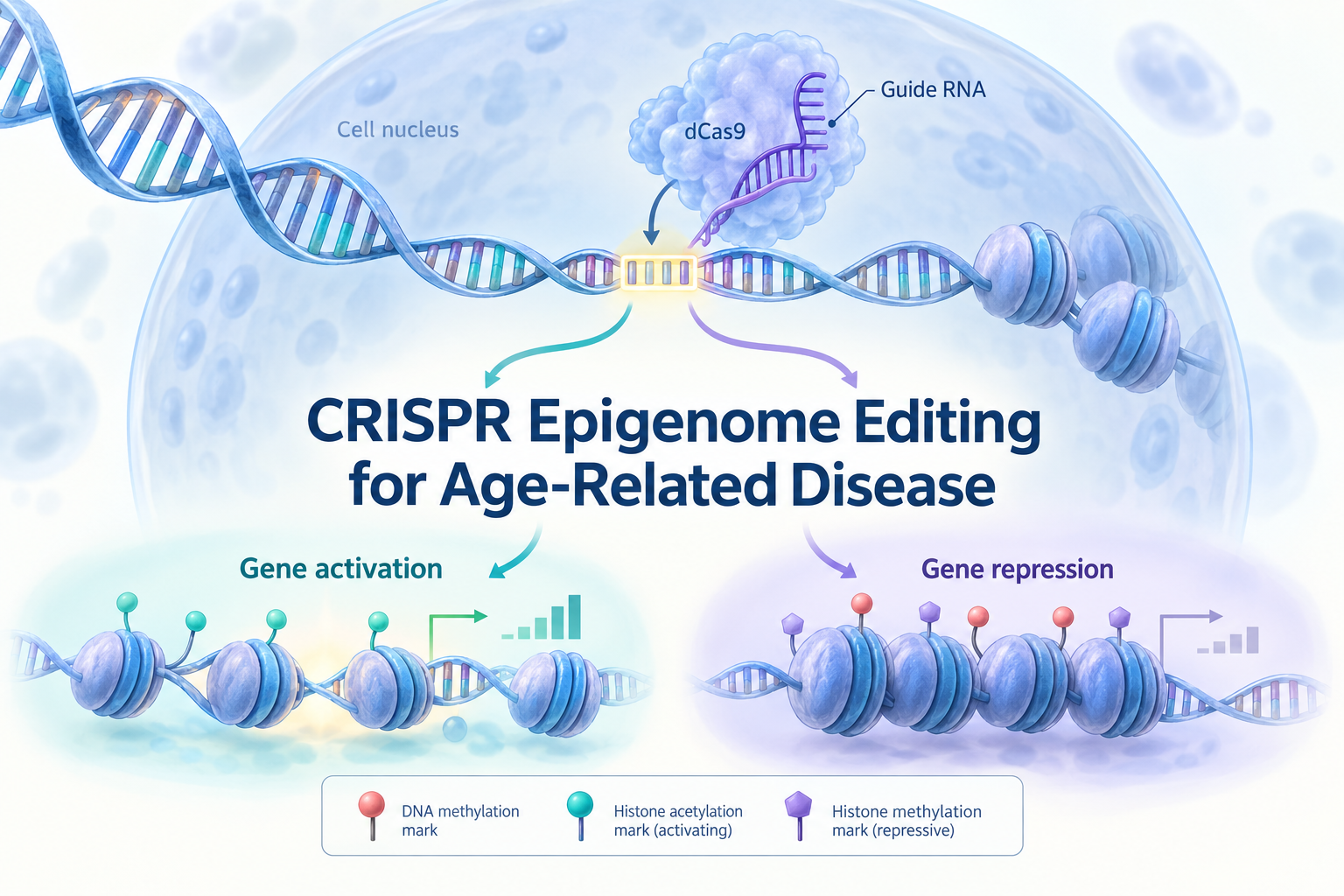
CRISPR epigenome editing often uses dCas9 instead.
The “d” stands for dead, meaning its DNA-cutting ability has been disabled.
That name can sound confusing because dCas9 is still biologically useful.
It can still travel to the correct DNA address.
It simply acts more like a delivery vehicle than molecular scissors. (Review)
A useful analogy is:
The guide RNA is the GPS. dCas9 is the delivery vehicle. The attached epigenetic enzyme is the tool being delivered.
CRISPR activation
CRISPR activation, often shortened to CRISPRa, attempts to turn a gene up.
Researchers can attach transcription-activating proteins or epigenetic enzymes to dCas9.
For example, the enzyme p300 adds acetyl tags to histone proteins around DNA. These tags are often associated with more accessible, active chromatin.
A dCas9-p300 system has been used experimentally to activate selected genes. (Research)
CRISPR interference
CRISPR interference, or CRISPRi, attempts to turn a gene down.
One common system joins dCas9 to a repressor called KRAB.
KRAB recruits proteins that make the targeted DNA region less accessible to the cell’s gene-reading machinery.
DNA-methylation editing
Another approach attaches dCas9 to a DNA methyltransferase.
A DNA methyltransferase is an enzyme that adds methyl chemical tags to DNA.
At some regulatory regions, increased methylation can help silence a gene.
DNA-demethylation editing
Scientists can instead attach dCas9 to enzymes such as TET1, which participate in removing DNA methylation.
This can reactivate some genes that have been abnormally silenced.
In patient-derived Fragile X cells, targeted TET1-based demethylation reactivated the silenced FMR1 gene. (Research)
Histone editing
DNA is wrapped around proteins called histones.
Together, DNA and its associated proteins form chromatin.
Chemical tags on histones help determine how tightly DNA is packaged and how easily genes can be read.
CRISPR systems can be designed to place or remove particular histone marks at chosen genes.
That gives researchers another way of changing gene activity without rewriting the DNA sequence.
Why It Happens (Causes & Risk Factors)
Ageing does not result from one gene being switched incorrectly.
Instead, ageing changes many layers of cellular regulation.
These include:
- DNA methylation
- histone modifications
- chromatin organization
- inflammation
- mitochondrial function
- DNA damage responses
- cellular senescence
- metabolism
Age-related diseases can also develop when specific genes become abnormally active or inactive.
That creates a potential role for epigenome editing.
The goal is not necessarily to “make every old cell young.”
It may be much narrower:
Find one disease-relevant gene whose activity is abnormal and reset that gene toward a more useful level.
This is why Parkinson disease, inherited retinal degeneration, and cholesterol biology are currently more realistic targets than whole-body age reversal.
Mechanisms / Pathophysiology
Step 1: choose a gene
Researchers first identify a gene whose activity appears to contribute meaningfully to disease.
For Parkinson disease, one candidate is SNCA.
SNCA produces α-synuclein.
Excess α-synuclein can contribute to abnormal protein accumulation associated with Parkinson disease.
Step 2: design the molecular address
Researchers design a guide RNA.
This is a short RNA molecule that recognizes a matching DNA sequence.
Its job is to guide the CRISPR system to the correct place.
Step 3: bring in dCas9
dCas9 binds the selected DNA region but does not make the usual double-strand cut.
This avoids one major feature of conventional CRISPR editing.
Step 4: deliver an epigenetic tool
Scientists attach a regulatory tool to dCas9.
Examples include:
- DNMT3A to add DNA methylation
- TET1 to promote DNA demethylation
- p300 to add histone acetylation
- KRAB to recruit repressive chromatin machinery
These names matter less than the underlying idea:
CRISPR chooses the address. The attached enzyme changes the regulatory environment at that address.
Step 5: gene activity changes
The targeted gene may become more active or less active.
Importantly, the DNA letters can remain unchanged.
Epigenetic memory
One of the most interesting possibilities is that the effect can sometimes outlast the editing machinery.
CRISPRoff was designed to create a repressive combination of DNA methylation and chromatin modifications.
Transient exposure produced gene silencing that persisted through cell division and, in experimental systems, even through cell differentiation. (Research)
This phenomenon is sometimes called epigenetic memory.
It means:
The editor can leave, but the regulatory state it created may remain.
That could be therapeutically useful.
It could also create safety concerns if an unwanted edit persists.
Epigenome editing is not partial reprogramming
This distinction is important for this series.
Partial cellular reprogramming attempts to shift large parts of a cell toward a younger gene-regulatory state.
CRISPR epigenome editing is generally much more targeted.
It aims to modify one gene or a defined set of genomic sites.
Therefore:
CRISPR epigenome editing is more like correcting selected regulatory switches than rebooting the whole cell.
Symptoms, Patterns, and Differential Clues
There is no clinical condition called “CRISPR-responsive ageing.”
Patients are not currently tested to determine whether they need an epigenome editor.
Instead, potential targets arise from specific diseases.
Examples include:
- abnormal α-synuclein expression in Parkinson disease
- abnormal regulation of retinal genes in inherited retinal degeneration
- excessive PCSK9 activity in cardiovascular-risk biology
- abnormal methylation-mediated gene silencing in some genetic disorders
Ageing itself is much broader than these conditions.
A treatment that successfully changes one gene involved in one disease should therefore not be described as whole-body rejuvenation.
Evaluation & Diagnosis (Clinical Context)
CRISPR epigenome editing is currently primarily a research technology.
Researchers evaluate several questions before considering therapeutic translation.
Is the target gene actually important?
A gene may be associated with disease without being a good treatment target.
Changing it has to produce a meaningful effect.
Can the editor reach the correct cells?
This is called delivery.
Delivery is one of the field’s biggest challenges.
Brain neurons, heart cells, skeletal muscle, retinal cells, and liver cells require very different delivery strategies.
Is the effect strong enough?
A modest change in gene expression may not be sufficient.
Is it too strong?
Completely switching off a gene can also be harmful if the gene has normal functions.
Does the effect last?
Some conditions may require temporary regulation.
Others may benefit from durable regulation.
Are unintended sites affected?
This is the off-target problem.
Off-target means the editor changes biology somewhere other than the intended location.
With epigenome editing, the concern is not limited to unintended DNA cutting.
Researchers also need to look for unintended methylation, histone changes, and gene-expression effects.
One genome-wide study of dCas9 methyltransferases identified more than 1,000 unintended differentially methylated regions with some constructs, demonstrating why specificity must be measured rather than assumed. (Research)
Treatment Options Snapshot (Evidence-Graded, Descriptive Only)
No CRISPR epigenome-editing treatment is established for normal human ageing.
Prescription / Medical Therapies
- SNCA-targeted epigenome editing for Parkinson disease — Human patient-derived neurons have been treated experimentally with CRISPR systems designed to reduce SNCA expression and α-synuclein-related cellular abnormalities. A recent mouse study also reported reduced pathological α-synuclein and improved motor behavior, but no human treatment efficacy has been established. Evidence: Emerging. (Research, Research)
- SNCA histone editing in Parkinson disease models — Researchers used targeted histone demethylation at the SNCA promoter in Parkinson patient-derived neurons. SNCA-associated activating histone marks and α-synuclein expression declined, supporting a causal regulatory mechanism but remaining at the cell-model stage. Evidence: Emerging. (Research)
- PCSK9 epigenetic silencing — Transient delivery of epigenetic editors has created durable PCSK9 suppression and lower LDL cholesterol in mice, and long-lasting silencing has also been demonstrated in nonhuman primates. This is among the strongest translational examples, but it has not established clinical efficacy of CRISPR epigenome editing in humans. Evidence: Emerging. (Research, Research)
- Retinal CRISPR activation — A dCas9-based gene-activation strategy increased expression of a compensating retinal gene in mice and produced improved retinal function and reduced retinal degeneration over long follow-up. This is compelling preclinical evidence but not human therapy evidence. Evidence: Emerging. (Research)
- Retinal CRISPR interference — dCas9-KRAB was used to repress rhodopsin in human retinal explants and a pig model of dominant retinitis pigmentosa. Rhodopsin suppression and photoreceptor preservation were demonstrated preclinically, but clinical benefit in patients remains untested. Evidence: Emerging. (Research)
- Klotho gene activation — CRISPR-dCas9 transcriptional activation increased Klotho RNA and protein expression in human neuronal and kidney cell lines. Although Klotho is strongly associated with ageing biology, this experiment did not establish cognitive improvement, disease prevention, or lifespan extension in humans. Evidence: Emerging. (Research)
Supplements / Vitamins (Research Context Only)
Thirty-eight supplement and supplement-like candidates were screened, including NMN, nicotinamide riboside, AKG, spermidine, sodium butyrate, omega-3 fatty acids, vitamin D, folate, vitamin B12, vitamin B6, SAMe, choline, betaine, methionine, GlyNAC, NAC, glycine, taurine, fisetin, quercetin, resveratrol, urolithin A, berberine, curcumin, sulforaphane, EGCG, CoQ10, alpha-lipoic acid, vitamins C and E, magnesium, zinc, selenium, melatonin, creatine, probiotics, prebiotics, and beta-hydroxybutyrate.
Available direct human supplement evidence was more limited than the evidence available for standard medical treatment categories in this condition.
Tier A — Strong / Moderate Evidence
No qualifying items.
No supplement has been shown in humans to function as a programmable CRISPR epigenome editor.
Tier B — Limited-Mixed Evidence
No qualifying items.
Several supplements can influence methylation, histone biology, NAD metabolism, inflammation, or chromatin regulation, but system-wide biochemical influence is not the same as guide-RNA-directed editing of a selected DNA locus.
Tier C — Emerging Evidence
No supplement qualified as a direct human CRISPR epigenome-editing intervention.
This is an important classification distinction rather than evidence that all of these compounds are biologically inactive.
For example:
- AKG can affect enzymes involved in DNA and histone demethylation.
- Butyrate can influence histone acetylation.
- Folate, B12, choline, and betaine participate in one-carbon metabolism that supplies methyl groups.
- NAD-related compounds can influence sirtuin biology.
Those are broad metabolic mechanisms.
CRISPR epigenome editing instead attempts to say:
“Change this regulatory mark at this chosen DNA address.”
The evidence categories should not be merged.
Topical / Cosmetic Ingredients (Research Context Only)
No topical or cosmetic ingredients met strict human-evidence inclusion criteria for this condition.
Available direct human topical/local evidence was limited for this condition.
Topical retinoids, vitamin C, niacinamide, rapamycin, metformin, resveratrol, spermidine, fisetin, quercetin, AKG, NAD-related formulations, and butyrate were screened.
Some affect skin biology or gene regulation.
None constitutes local CRISPR-guided epigenome editing in humans.
Dietary Sources (Research Context Only)
Direct human dietary-source evidence was narrower than the target item count.
Mediterranean diets, calorie restriction, fasting patterns, ketogenic diets, plant-rich diets, fibre-rich diets, fermented-food patterns, methyl-donor-rich diets, folate-rich diets, choline-rich diets, protein restriction, and low-methionine approaches were screened.
Diet can change metabolism and sometimes measurable epigenetic patterns.
It cannot currently direct dCas9 to a specific gene.
No dietary intervention met the inclusion requirement for CRISPR epigenome editing.
What Research Has Studied
- Turning selected genes on using dCas9-linked transcriptional activators. (Research)
- Turning genes on by adding histone acetylation at selected promoters or enhancers. (Research)
- Creating durable gene silencing through DNA methylation and repressive chromatin. (Research)
- Removing abnormal DNA methylation to reactivate a silenced gene. (Research)
- Reducing SNCA expression in Parkinson patient-derived neurons. (Research)
- Reducing Parkinson-related pathology and motor abnormalities in mice through SNCA epigenome repression. (Research)
- Activating Klotho in human cells as an ageing-related research target. (Research)
- Activating and repressing genes in retinal degeneration models. (Research, Research)
- Long-lasting PCSK9 silencing as a cardiovascular-risk strategy. (Research, Research)
- Off-target methylation and methods intended to improve editor specificity. (Research, Research)
Safety, Interactions & Regulatory Context
The apparent attraction of CRISPR epigenome editing is that it may regulate a gene without intentionally introducing a permanent DNA-sequence change.
That does not make it automatically safe.
Off-target epigenetic changes
An editor may modify methylation or chromatin outside the intended DNA site.
This could alter unrelated genes.
Early dCas9 methyltransferase studies demonstrated substantial unintended methylation with some configurations. (Research)
Newer systems have therefore been engineered specifically to improve specificity. (Research)
Too much target effect
Even perfect targeting can be unsafe if the chosen gene is suppressed or activated too strongly.
Genes often serve several functions.
A disease-promoting level of gene activity does not necessarily mean zero activity is desirable.
Persistence
Epigenetic memory can be an advantage if one treatment produces lasting benefit.
It becomes a concern if an unintended change is also long lasting.
Delivery
Editors must reach the intended cells.
Delivery to liver is relatively advanced because lipid nanoparticles can efficiently reach hepatocytes.
Delivery to widespread brain regions, heart tissue, skeletal muscle, and other ageing-related organs remains considerably more difficult. (Review)
Immune responses
Cas proteins and viral delivery systems can be recognized by the immune system.
This is an important issue for repeated or long-lasting expression.
Germline concerns
Age-related therapeutic research is generally focused on somatic cells—the cells of the body—not reproductive cells.
Changes capable of affecting eggs, sperm, or future generations raise substantially different safety and ethical questions.
Evidence Overview
CRISPR epigenome editing is one of the clearest examples of genuine epigenetic engineering in this series.
Unlike metformin, omega-3 fatty acids, butyrate, AKG, or other broad biological modulators, CRISPR systems can theoretically be directed toward one selected regulatory region.
That provides unusual precision.
The basic technology is well established
Researchers have repeatedly shown that dCas9 can deliver regulatory machinery to chosen DNA locations.
It can activate genes.
It can repress genes.
It can add DNA methylation.
It can promote removal of DNA methylation.
It can alter histone marks. (Review)
Persistent epigenetic memory is possible
CRISPRoff showed that temporary delivery can sometimes produce long-lived gene silencing. (Research)
This makes epigenome editing more than temporary gene suppression.
In principle, an editor might reset a regulatory state and then disappear.
Disease-specific preclinical evidence is increasingly persuasive
Parkinson disease is a particularly important example.
Human patient-derived neurons show that targeted SNCA methylation or chromatin repression can reduce excess α-synuclein and improve disease-related cellular abnormalities. (Research, Research)
A recent mouse study extended that approach in vivo and reported reduced α-synuclein pathology, preservation of dopaminergic markers, and improved motor behavior. (Research)
That represents meaningful progress.
It remains preclinical.
PCSK9 demonstrates durability and delivery
The cardiovascular field provides another powerful example.
Transient delivery of epigenetic repressors to mouse liver produced durable Pcsk9 silencing even after liver regeneration. (Research)
Later work demonstrated long-lasting suppression in nonhuman primates together with lower LDL cholesterol. (Research)
This shows that epigenetic editing can potentially create a durable physiological effect in a large animal without conventional permanent sequence editing.
Human translation has begun—but not for ageing
The wider epigenetic-silencing field entered human testing for chronic hepatitis B.
Early 2026 clinical data demonstrate that direct epigenetic silencing can produce measurable effects in patients. (Authority)
That is a translational milestone.
It should not be turned into the claim:
“CRISPR epigenome editing has been proven in human ageing.”
It has not.
Whole-body age reversal is a much larger problem
Ageing involves thousands of regulatory changes across many tissues.
Correcting one gene can potentially treat one disease mechanism.
That is very different from safely restoring an entire aged epigenome.
The realistic near-term path is therefore more likely to involve:
precise treatment of specific age-related diseases
rather than:
editing ageing itself throughout the body.
Evidence Confidence Classification
Overall Rating: Emerging
Confidence is Strong that CRISPR-based systems can selectively alter gene regulation in cells and that targeted epigenetic states can sometimes persist. Confidence is Moderate for disease-relevant preclinical effects in selected models such as Parkinson disease, retinal degeneration, and PCSK9 biology. Evidence remains Emerging for human therapeutic use and is insufficient for claims of human age reversal or lifespan extension. (Review, Research)
What Does Not (Evidence Gaps)
- CRISPR epigenome editing as proven human rejuvenation — No qualifying human study reviewed here demonstrates reversal of normal ageing, reduced biological age throughout the body, or longer human lifespan. Most ageing-related applications remain preclinical. (Review)
- Klotho activation as proven anti-ageing therapy — CRISPR activation increased Klotho expression in human cell lines, but that experiment did not demonstrate improved human cognition, slower ageing, or longer life. (Research)
- Parkinson epigenome editing as an established treatment — SNCA-targeted systems produce promising effects in human neurons and mice, but clinical benefit in people with Parkinson disease has not yet been established. (Research)
- “No DNA cutting” as meaning “no off-target risk” — Epigenome editors can produce unintended methylation or chromatin effects even when DNA is not intentionally cut. (Research)
- Supplements as substitutes for targeted epigenome editing — Nutrients and supplements can affect metabolism and sometimes epigenetic marks globally, but they cannot currently guide an editor to a chosen genomic address in a human patient.
- Changing one ageing-related gene as equivalent to reversing ageing — Disease-specific gene regulation may improve one biological pathway without resetting the many cellular systems involved in organismal ageing.
FAQ
1. What is CRISPR epigenome editing?
It is a way of using CRISPR targeting to change how a selected gene is regulated without necessarily changing the DNA sequence.
The CRISPR machinery identifies the DNA address, while an attached regulatory tool changes the local epigenetic environment. (Review)
2. How is this different from ordinary CRISPR?
Ordinary CRISPR-Cas9 commonly cuts DNA so that the DNA sequence can be disrupted or changed.
Epigenome editing often uses a non-cutting Cas protein and changes regulatory marks instead.
3. What is dCas9?
dCas9 means deactivated Cas9.
It can still be guided to a selected DNA sequence but has been engineered so that its usual DNA-cutting ability is disabled.
4. What does the guide RNA do?
The guide RNA acts like an address label.
Its sequence directs the CRISPR system toward a matching DNA location.
5. Does epigenome editing change DNA letters?
It does not have to.
Many systems alter methylation, histone marks, or transcriptional regulation while leaving the underlying DNA sequence unchanged. (Review)
6. What is CRISPRa?
CRISPRa means CRISPR activation.
It uses a targeted CRISPR system to increase activity of a selected gene.
7. What is CRISPRi?
CRISPRi means CRISPR interference.
It uses targeted CRISPR machinery to reduce transcription of a selected gene without necessarily cutting the gene.
8. What is CRISPRoff?
CRISPRoff is an experimental system designed to establish persistent gene silencing through DNA methylation and repressive chromatin marks.
The resulting silencing can remain after the editor itself is gone. (Research)
9. What is epigenetic memory?
Epigenetic memory means a gene-regulatory state can persist after the original trigger has disappeared.
In treatment research, that could allow temporary delivery of an editor to create a longer-lasting biological effect.
10. Could CRISPR epigenome editing treat Parkinson disease?
It is a credible research direction, but not an established treatment.
Targeted reduction of SNCA has improved disease-related biology in patient-derived neurons and mouse models. Human therapeutic efficacy remains unproven. (Research, Research)
11. Why target SNCA?
SNCA produces α-synuclein.
Excess or abnormal α-synuclein is central to Parkinson disease and related disorders, making controlled reduction of SNCA expression a potential therapeutic strategy.
12. Could it be used for high cholesterol?
PCSK9 epigenetic silencing has produced durable LDL-cholesterol reductions in animal studies.
Large-animal results are encouraging, but human clinical efficacy of this specific epigenome-editing strategy has not yet been established. (Research)
13. Why is PCSK9 important?
PCSK9 helps regulate receptors that clear LDL cholesterol from the blood.
Reducing PCSK9 activity can increase LDL-receptor availability and lower circulating LDL cholesterol.
14. Can CRISPR epigenome editing increase Klotho?
Researchers have activated the Klotho gene with CRISPR-dCas9 in human neuronal and kidney cell lines.
That demonstrates targeted gene activation, not proven human anti-ageing benefit. (Research)
15. Could it treat retinal disease?
Preclinical studies suggest so.
Researchers have used CRISPR activation to increase compensating retinal genes and CRISPR interference to suppress harmful rhodopsin expression. (Research, Research)
16. Is epigenome editing safer than gene editing?
It may avoid some risks associated with intentionally cutting both DNA strands, but that does not make it automatically safer.
Off-target epigenetic modifications, delivery problems, immune responses, and overly persistent effects remain concerns. (Research)
17. Can an unwanted epigenetic edit be reversed?
Some epigenetic states are potentially more reversible than DNA-sequence edits.
However, durable systems are specifically designed to create memory, so practical reversal of an unintended effect cannot simply be assumed.
18. Can supplements perform epigenome editing?
Not in the CRISPR sense.
Nutrients can influence cellular metabolism and broad epigenetic processes, but they do not currently use a guide RNA to alter a selected regulatory mark at a chosen human DNA site.
19. Has CRISPR epigenome editing reversed human ageing?
No.
There is currently no qualifying human evidence showing that targeted CRISPR epigenome editing reverses normal ageing or extends human lifespan.
20. What is the simplest conclusion?
CRISPR epigenome editing is one of the most precise forms of epigenetic engineering currently under development.
It has produced convincing gene-specific effects in cells, mice, and some large-animal models.
The major unanswered question is whether that precision can be delivered safely enough to produce meaningful benefit in people with age-related diseases.
Resources
CRISPR Technologies for Precise Epigenome Editing — Review — https://pubmed.ncbi.nlm.nih.gov/33420494/
Epigenome Engineering: New Technologies for Precision Medicine — Review — https://pubmed.ncbi.nlm.nih.gov/33196851/
Epigenome Editing by a CRISPR-Cas9-Based Acetyltransferase — Research — https://pubmed.ncbi.nlm.nih.gov/25849900/
Genome-Wide Programmable Transcriptional Memory by CRISPR-Based Epigenome Editing — Research — https://pubmed.ncbi.nlm.nih.gov/33838111/
Genome-Wide On-Target and Off-Target Characteristics of dCas9 Methyltransferases — Research — https://pubmed.ncbi.nlm.nih.gov/29635374/
Modular dCas9-SunTag DNMT3A Epigenome Editing — Research — https://pubmed.ncbi.nlm.nih.gov/29907613/
In Vivo Target Gene Activation by CRISPR-Mediated Trans-Epigenetic Modulation — Research — https://pubmed.ncbi.nlm.nih.gov/29224783/
Activation of Klotho by CRISPR-dCas9 — Research — https://pubmed.ncbi.nlm.nih.gov/29352444/
Targeted DNA-Methylation Editing of SNCA in Parkinson Disease Models — Research — https://pubmed.ncbi.nlm.nih.gov/30266652/
Targeted Histone Editing at SNCA in Parkinson Disease — Research — https://pubmed.ncbi.nlm.nih.gov/33428332/
Neuron-Type-Specific SNCA Epigenome Editing — Research — https://pubmed.ncbi.nlm.nih.gov/38130373/
SNCA-Targeted Epigenome Therapy in a Parkinson Disease Mouse Model — Research — https://pubmed.ncbi.nlm.nih.gov/40667079/
CRISPRi-Mediated Treatment of Dominant Rhodopsin-Associated Retinitis Pigmentosa — Research — https://pubmed.ncbi.nlm.nih.gov/38108516/
dCas9-VPR Gene Activation for Inherited Blindness — Research — https://pubmed.ncbi.nlm.nih.gov/32875106/
DNA-Methylation Editing of FMR1 in Fragile X Neurons — Research — https://pubmed.ncbi.nlm.nih.gov/29456084/
Durable In-Vivo Gene Silencing by Epigenome Editing — Research — https://pubmed.ncbi.nlm.nih.gov/38418872/
Optimized Epigenetic Regulators Targeting PCSK9 in Nonhuman Primates — Research — https://pubmed.ncbi.nlm.nih.gov/41034497/
mRNA-Engineered CRISPR Epigenetic Editors for Durable Gene Silencing — Research — https://pubmed.ncbi.nlm.nih.gov/41789142/
TUNE-401 Phase 1b/2a Epigenetic-Silencing Clinical Data — Authority — https://tunetx.com/tune-therapeutics-presents-positive-phase-1b-2a-proof-of-concept-data-on-tune-401-a-first-in-class-epigenetic-silencer-for-patients-with-hepatitis-b-at-easl-2026/